Self-Analysis Final Project

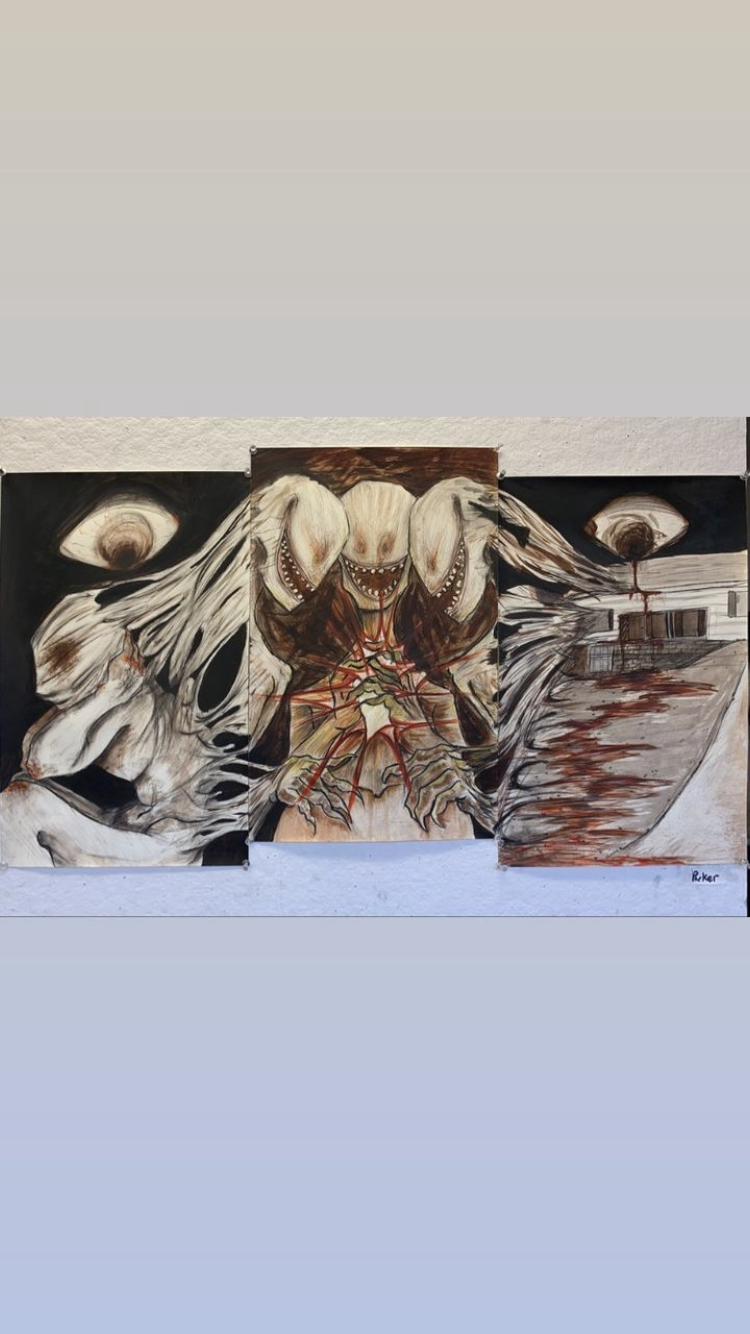
My chosen theme for my Visual Thinking course final was my biggest fear. My biggest fear is one of failure and the resulting aftermath of my supposed failure. I have gotten better at managing this fear but when I was younger this fear felt very controlling and overbearing toward my well-being. My success and failure are always being watched, monitored, and criticized.

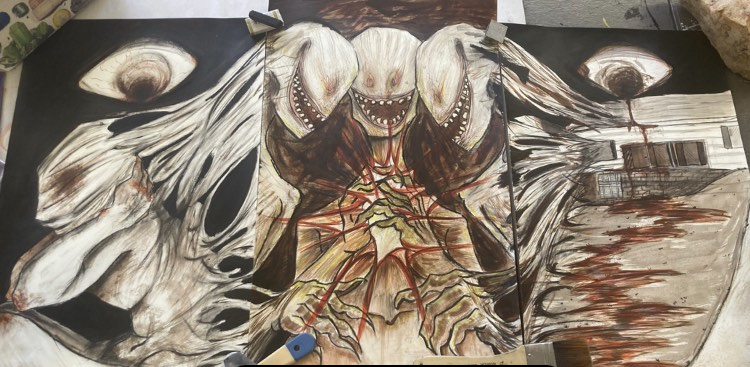
Some of the techniques I used were dry brushing in the background of the middle piece. I would flick paint/ink off my brush on the figures in the middle piece as well to represent blood splatter from my head exploding. I also dabbed my damped brush in the ink, diluting it with water to make a transparent texture on the figure’s eye and body on the left. I did solid, opaque strokes on the backgrounds of the left and right artworks to bring more focus to the objects presented. I wanted the middle piece to have a more chaotic background to go hand in hand with the built-up pressure on myself (resulting in the exploding head).
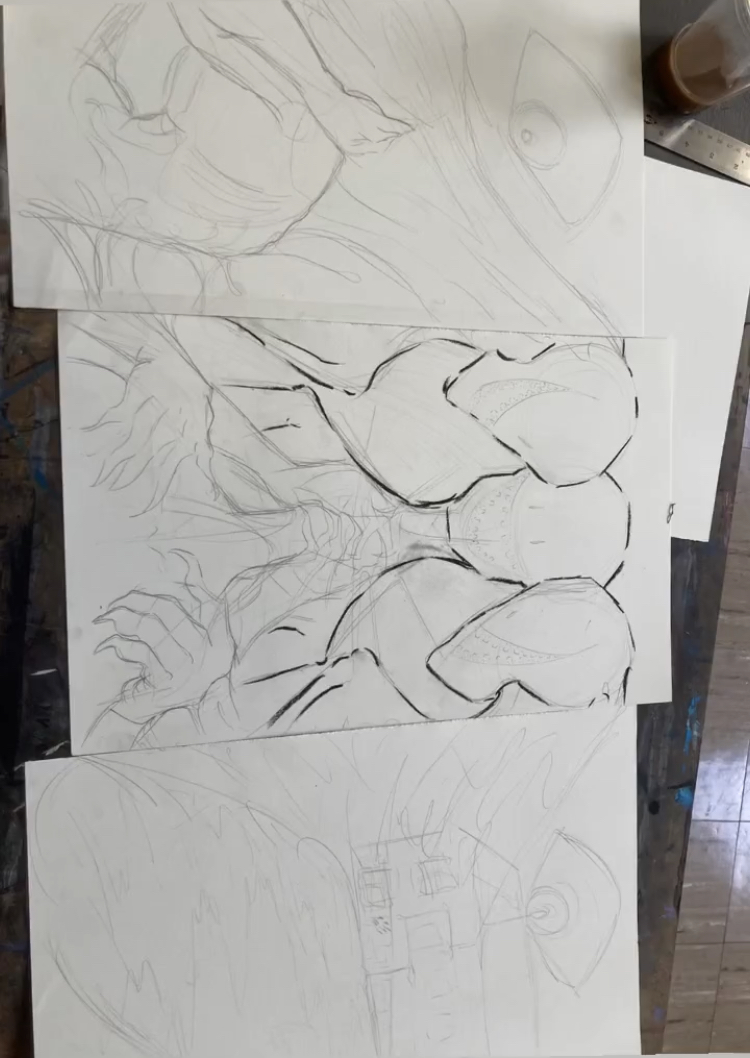
I mainly used ink and compressed charcoal for the materials but, I did add a little watercolor for the transparency of the colors. I sketched out the drawing with a pencil first. I made sure to block out anything I wanted to keep lighter, that way when I went in with the darker colors I don’t cover something up by accident.

I know in my other art assignments, I didn’t do anything with the backgrounds, I mainly did solid colors. So for this assignment, I wanted to try doing things with the backgrounds like adding the eyes, making dry-brushed marks, and even adding a building. I also wanted the pieces to connect so I drew them in a way that they stretched into one another while also being stand-alone pieces. I thought this was pretty symbolic of me still being stuck and affected by the circumstances of my past that led me to this fear of failure.

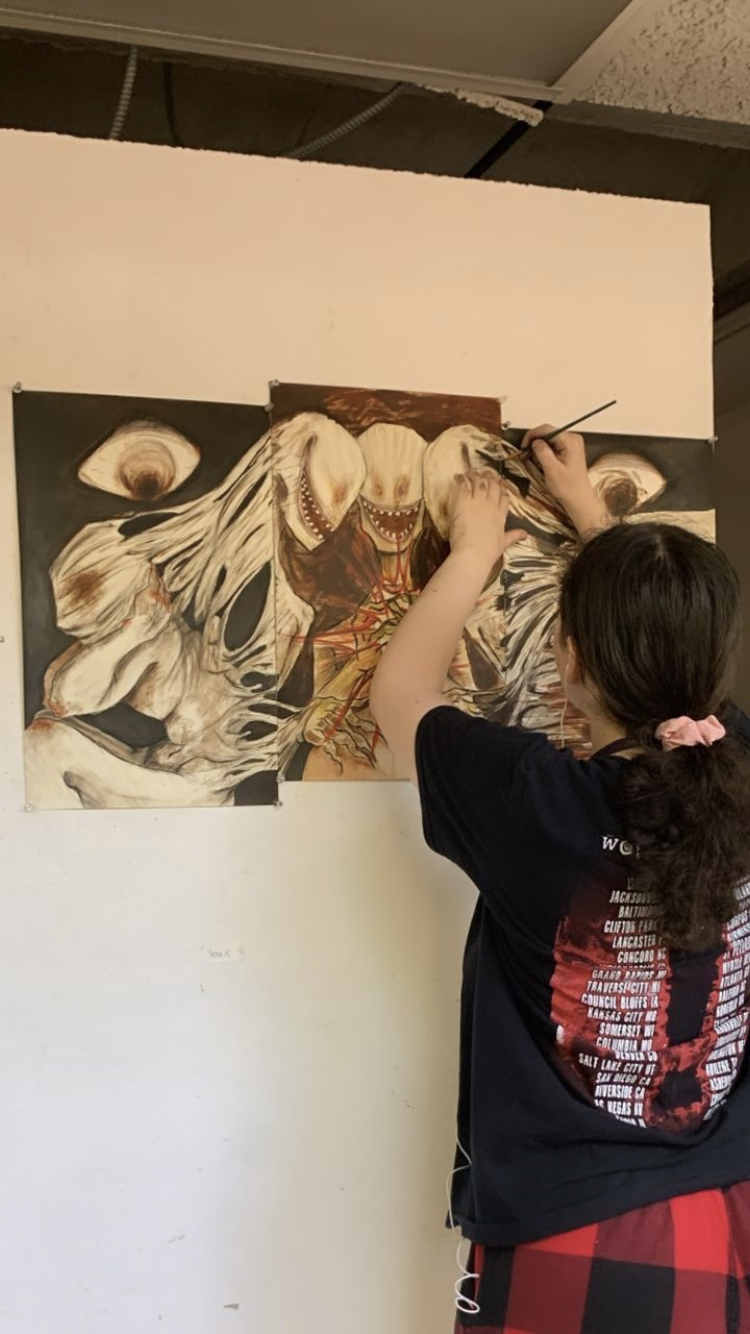
I did struggle to match up the pieces together. That is why in the photo, you see me adding details so the images fully connect with each other. I also struggled with drawing the house, I mainly do characters or people so it was a nice challenge to draw a building. The house is the house I lived in during my childhood so I did use a reference photo when drawing it but it was still very difficult.

I wish I definitely would’ve taken my time when doing these drawings. I should’ve savored the feelings I had when creating these pieces but I felt I could’ve added more and refined it a lot more as well. The first 2 drawings turned out surprisingly better than I thought they would. The last drawing, however, didn’t live up to my own standards and I felt like I probably should’ve redone it because I wasn’t as happy about it as the other 2. I believe this piece conveyed the emotions I wanted it to but it was a struggle to do because of everything I went through and experienced because of this fear.
Journeys: Agnes Scott and Palmento Grove

Agnes Scott College provides their first-year students the opportunity to go on an immersion experience during a week called, Peak Week. This experience, Global Journeys, can be outside or within the United States. My journey experience was to Belize in Central America. The purpose of this trip was to allow students to experience global issues and course concepts in a hands-on method of learning. The main concepts presented within my Global Journey class were colonialism, ethics of travel, globalization, and identity. I want to focus primarily on identity and globalization as I write about the cultural foods I ate throughout my experience in Belize.

The way I prepared for this journey was by doing a lot of class readings on Belize. I looked at some cultural norms in Belize that were helpful when actually visiting. One tip I remember was with the issue of cat-calling, women are not to engage or that would influence the man to continue what they’re doing. Some of the readings we did to prepare were A Small Place by Jamaica Kincaid, The Last Flight of the Scarlet Macaw by Bruce Barcott, Time Among the Maya by Ronald Wright, and Souse, but No Black Pudding from Clarke and Lorde. I physically prepared by packing light clothing, a journal to take notes, and hygiene products under 3 oz.

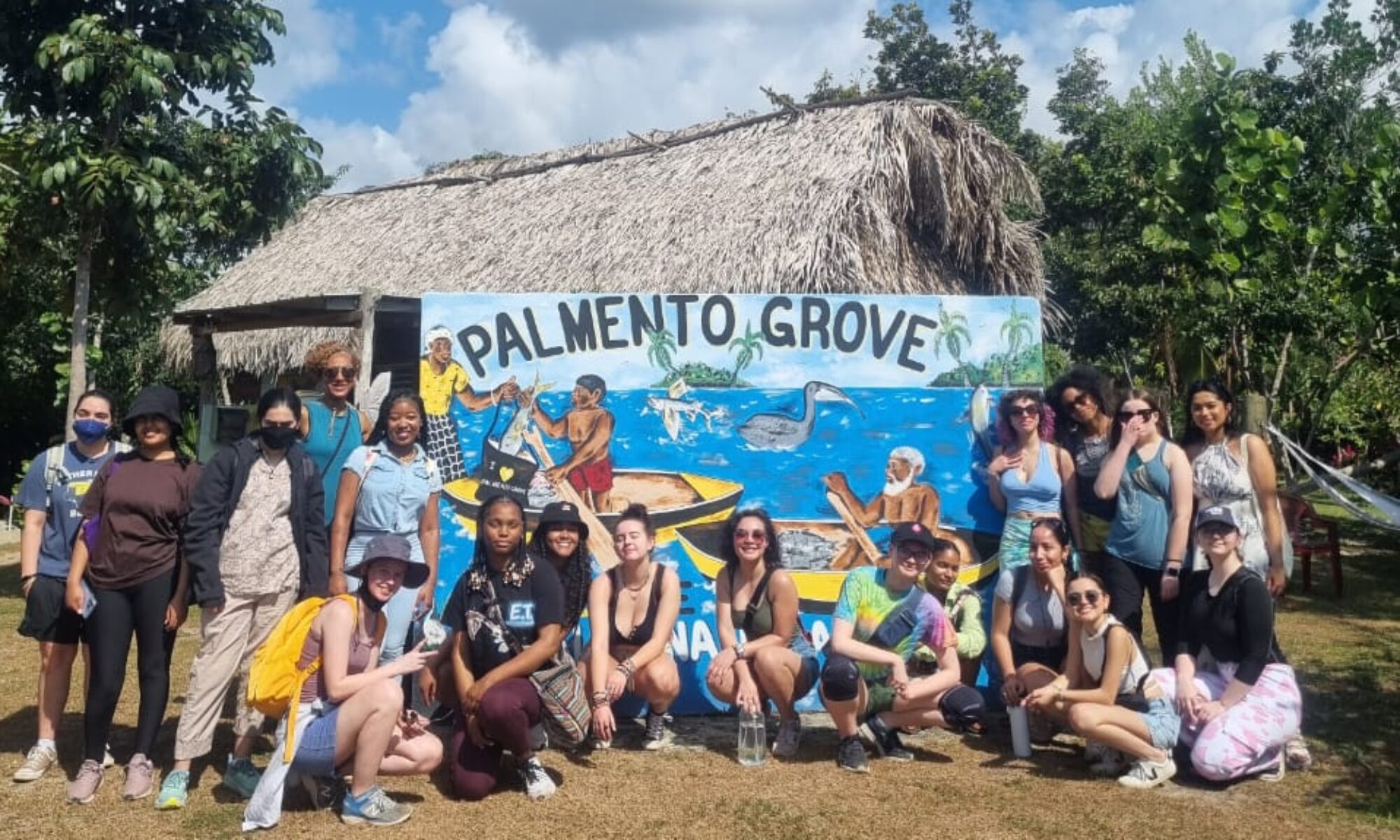
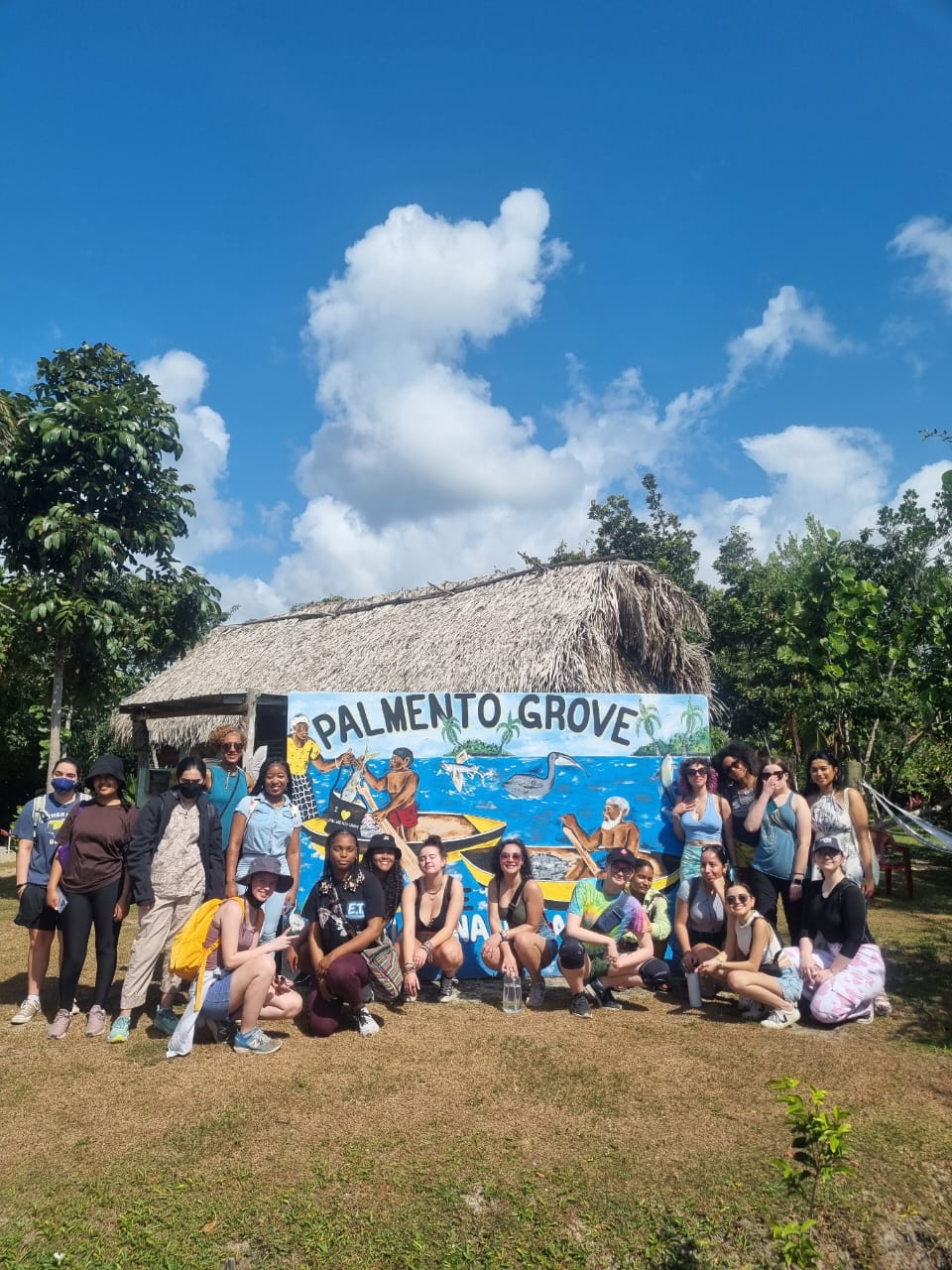
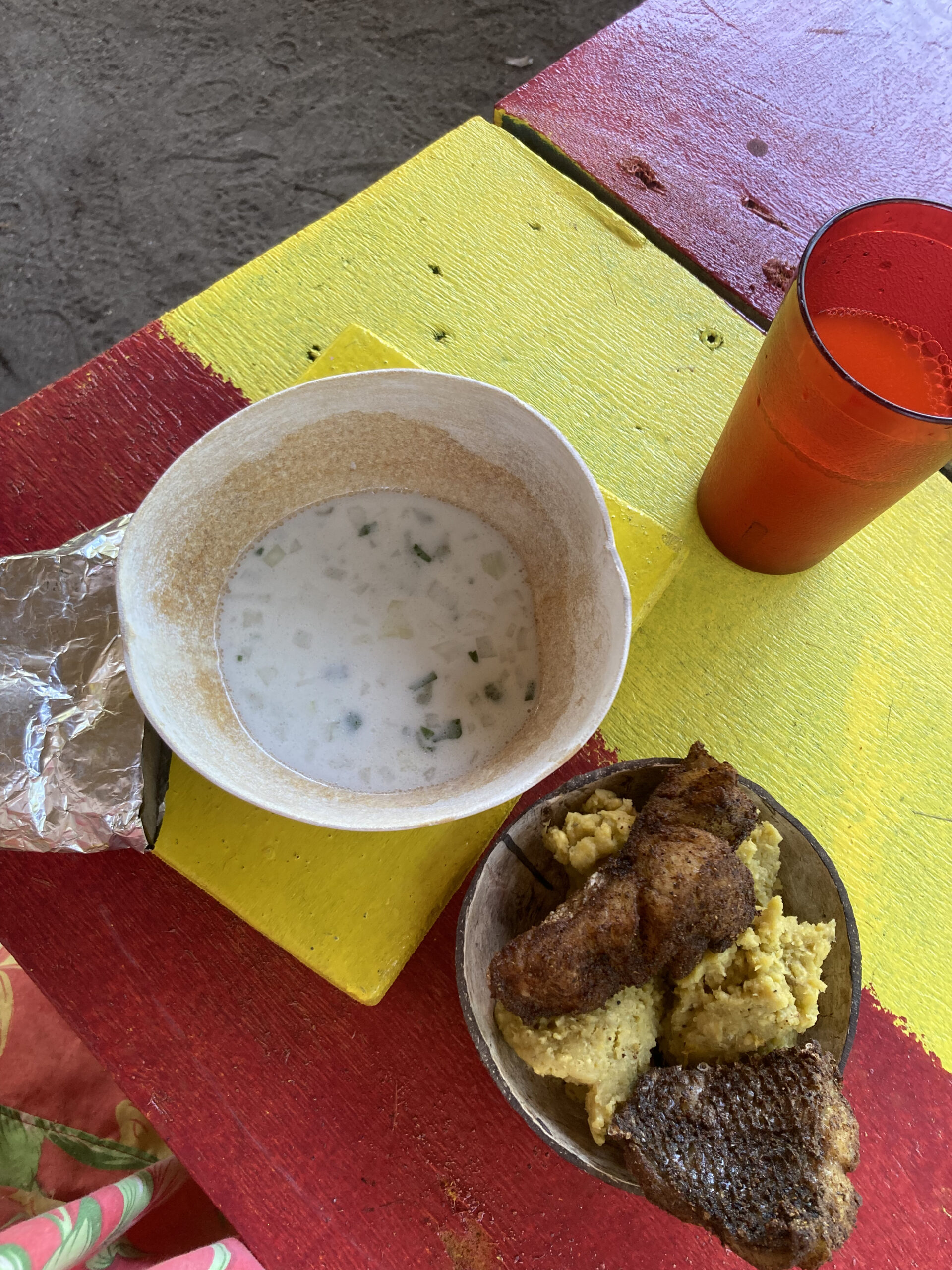
Group photo and Hudut: Photos Provided by the instructors and me

One of the first places I visited in Belize was the Garifuna community in Palmento Grove. The person giving us insight into what activities my group and I would be doing in Palmento Grove was Uwhanie. One of the activities we did was to make a dish called Hudut. Before we could begin making Hudut, Uwhanie showed us the different plants her community was growing along with the various benefits they could provide. My group also had to change into some traditional Garifuna garments considering we would be outside and the clothing would help us regulate the heat. Afterward, she brought us to her father who gave a quick history of the Garifuna and aspects that contributed to their culture. The Garifuna believe in harmony in the universe. Darkness cannot exist without light, life cannot exist without death, etc. Another aspect that contributed to Garfuna’s identity was how well a woman could tell the difference between the shades of a coconut. Uwhanie made a joke that if a woman wanted to impress a man and his family but couldn’t tell the difference between the coconuts, he would have asked what planet she even came from.

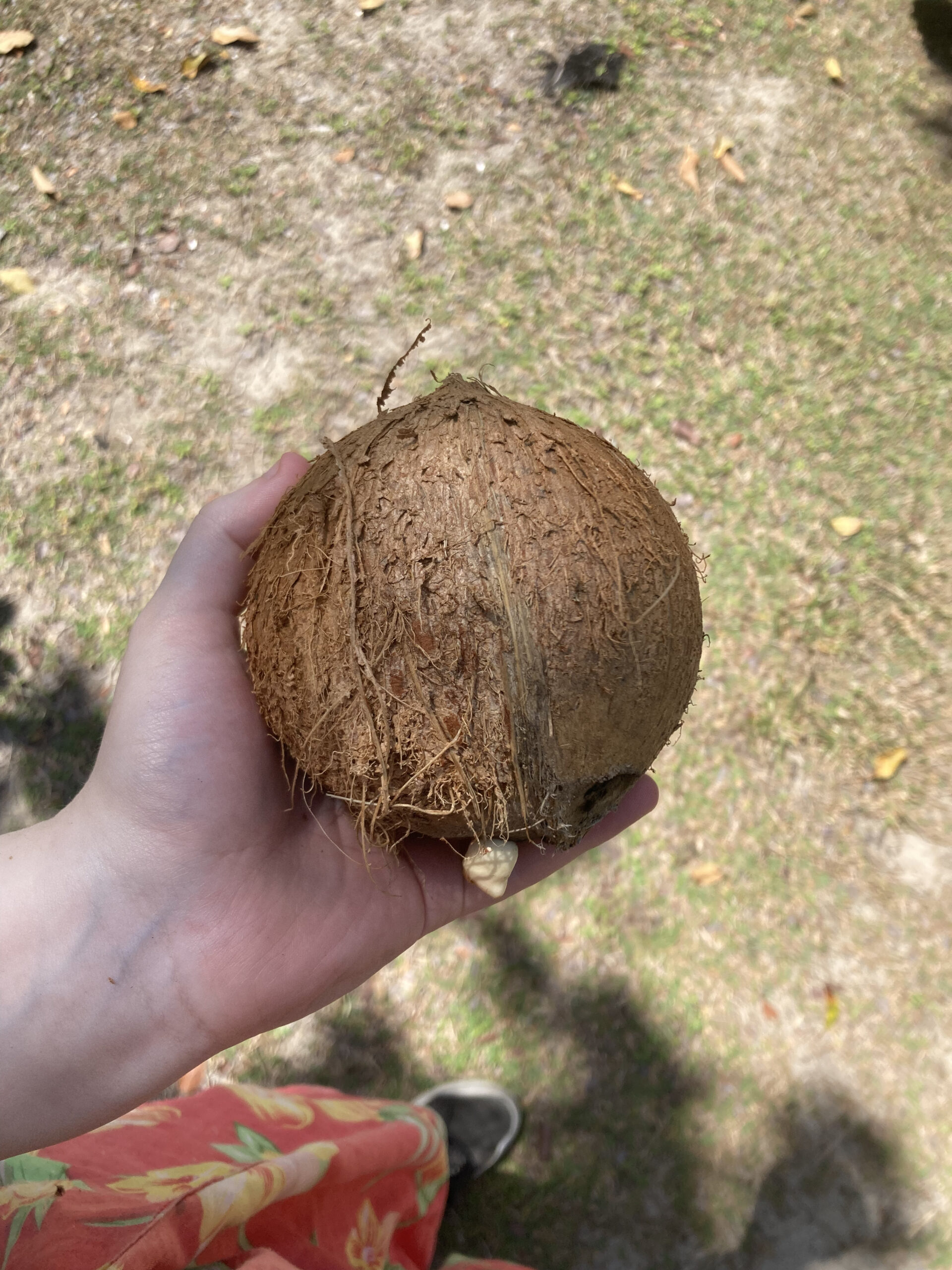
husked coconut: Photo Provided by me

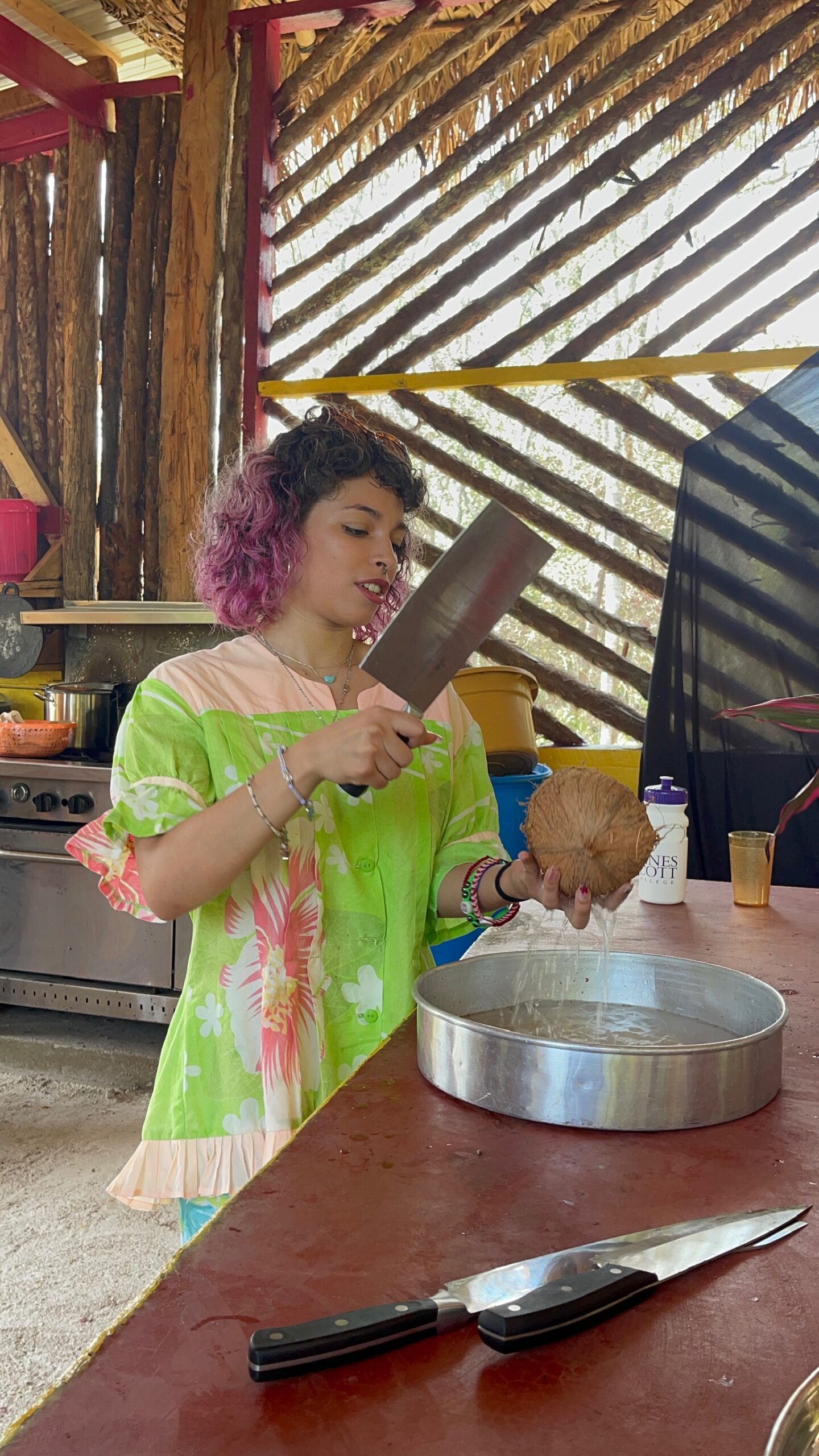
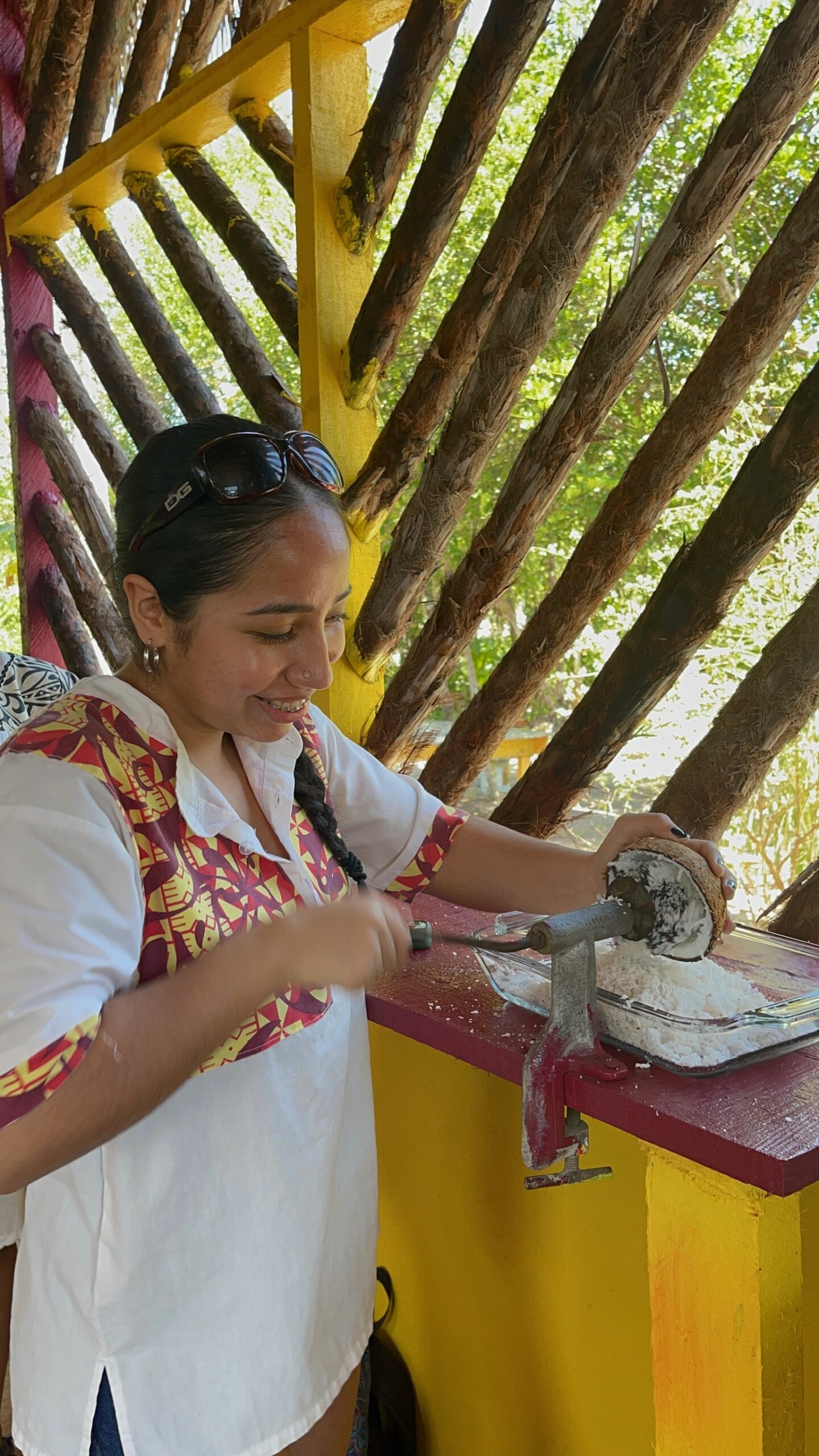
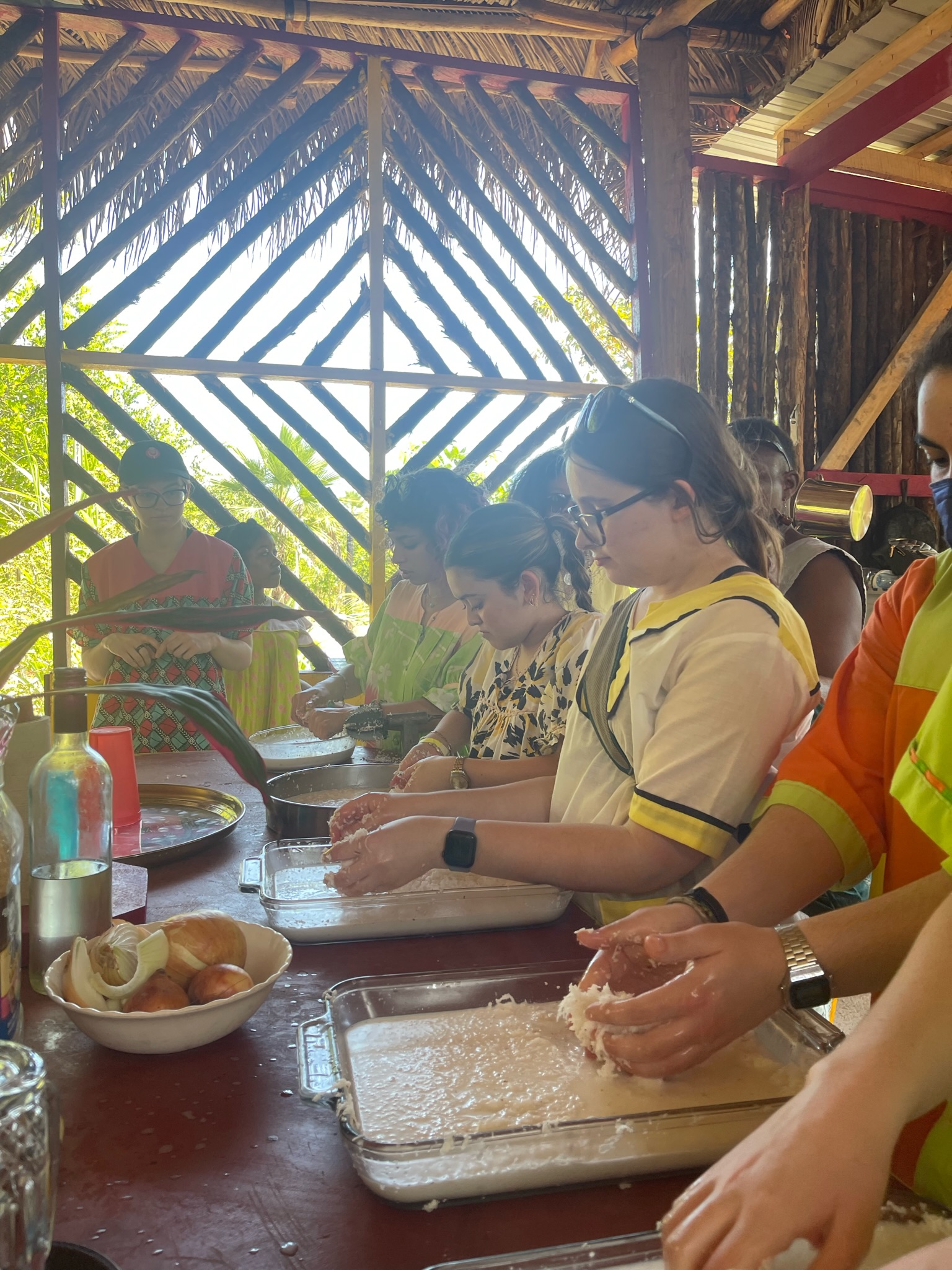
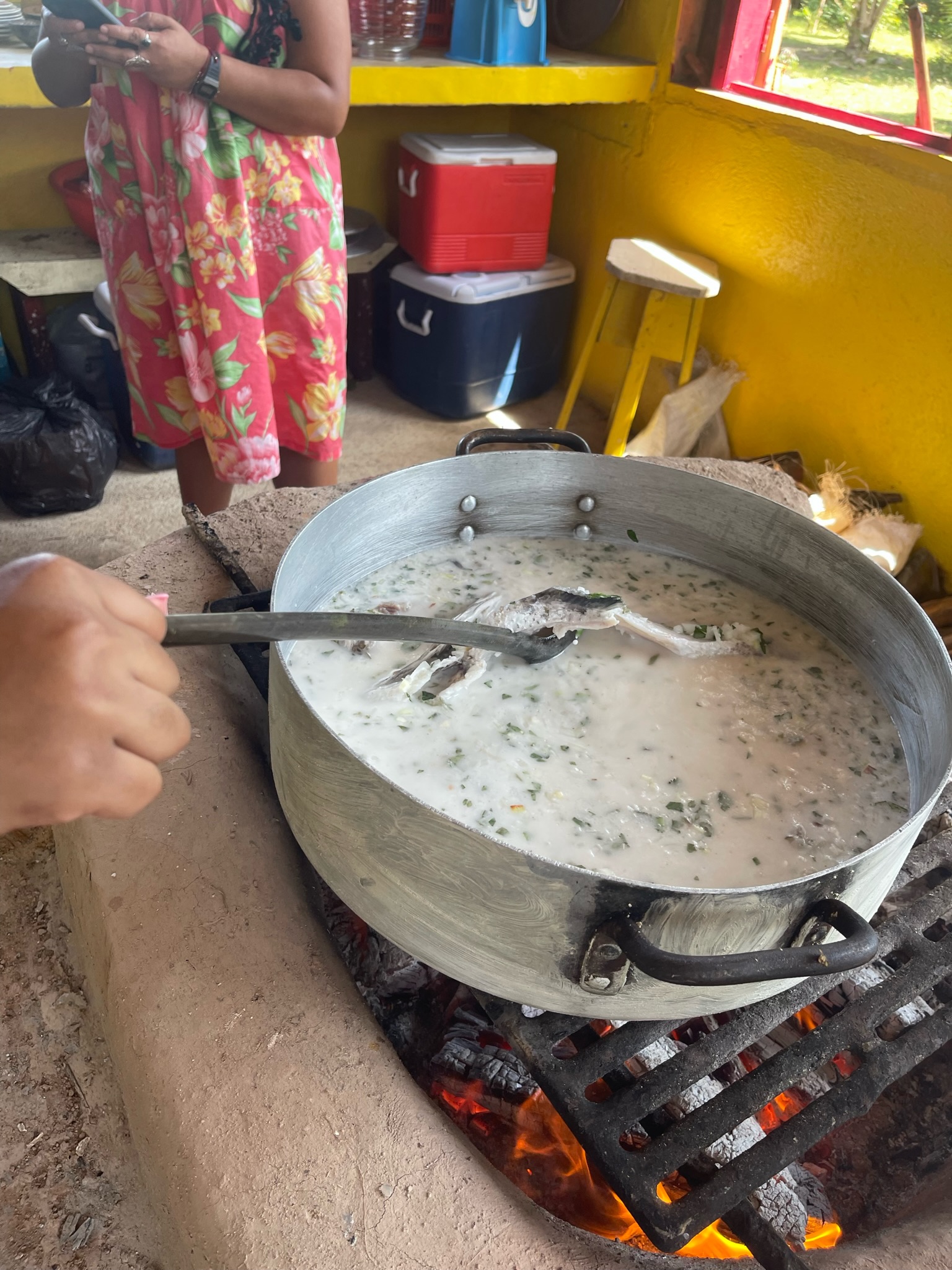
Our first task in the process of Hudut making was to husk the coconuts. There was a giant spike in the ground where Uwhanie demonstrated pushing the coconut onto the spike and ripping the shell off. She used the grooves of the coconut to better leverage and pull apart the husks. After the majority of people in the group were able to husk a coconut, we headed over to the kitchen where we next had to crack open the coconut. We each took turns with our coconuts and hit them with the back of a big knife to crack them open and get the coconut water from inside. After opening the coconut, we then had to use a shredder to clean out the actual meat from the coconut in preparation to make coconut milk. After all the coconut had been shredded, water was added to the dishes of coconut which we kneaded with our hands. We next had to strain the coconut milk to be used as a broth for the fish stew. There were other spices and herbs added to the stew for flavor as well. The fish used for the stew was barracuda. Once the barracuda was added to the coconut milk broth, the pot was then transferred to a stovetop which was stirred continuously.

Jenesis cracking a coconut, Samantha shaving a coconut, classmates washing the shaved coconut, and fish stew being stirred: Photos Provided by Anika

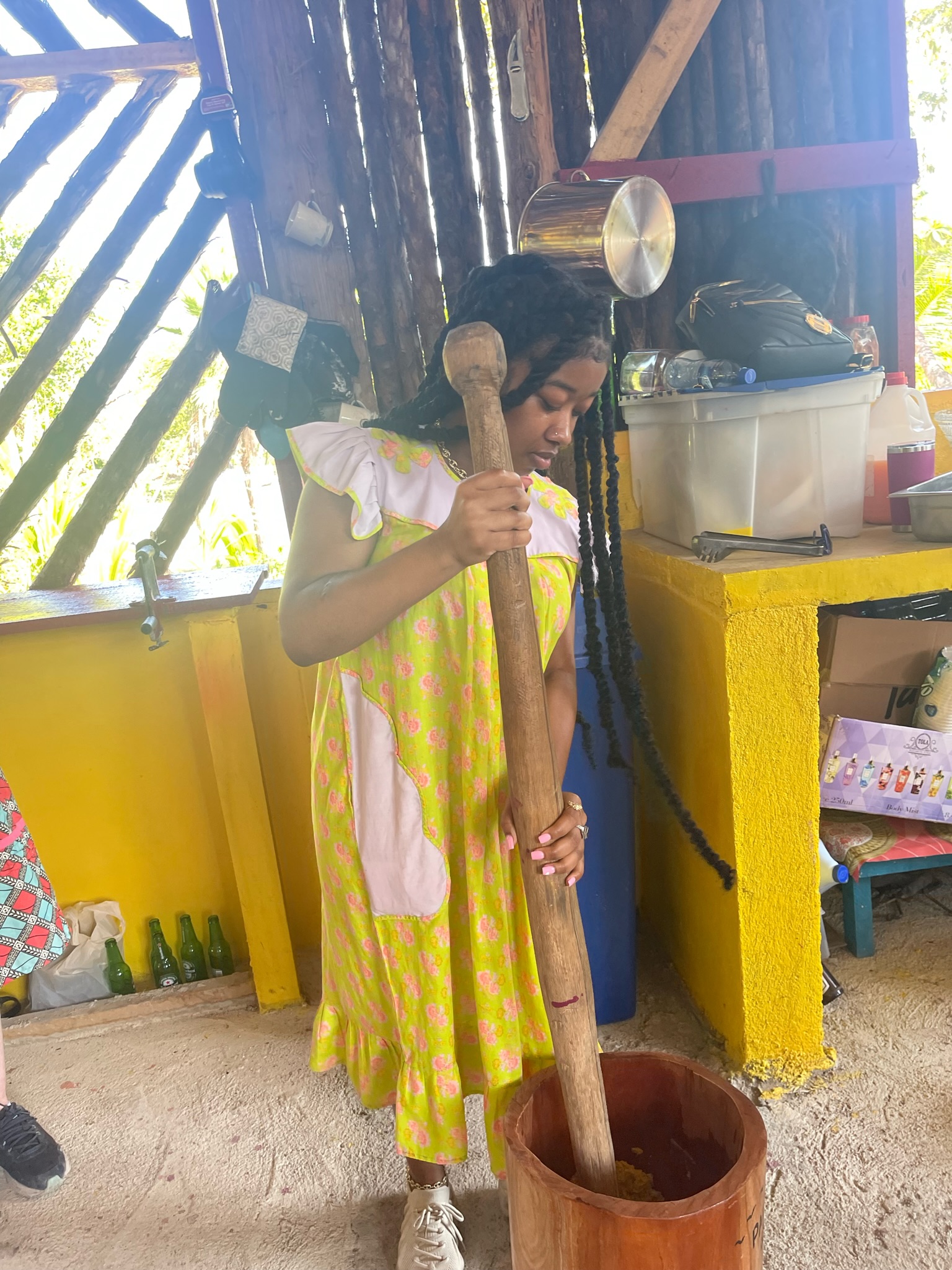
The main reason this dish was called Hudut is due to the mashing process. While the stew was being stirred, Uwhannie’s father took out a large mortar and pestle and mashed together both green and yellow plantains. The plantains were mashed until they turned into a sort of paste. Our group each took turns to mash the plantains with a pound and twist motion of the pestle as it hit the plantains in the mortar.

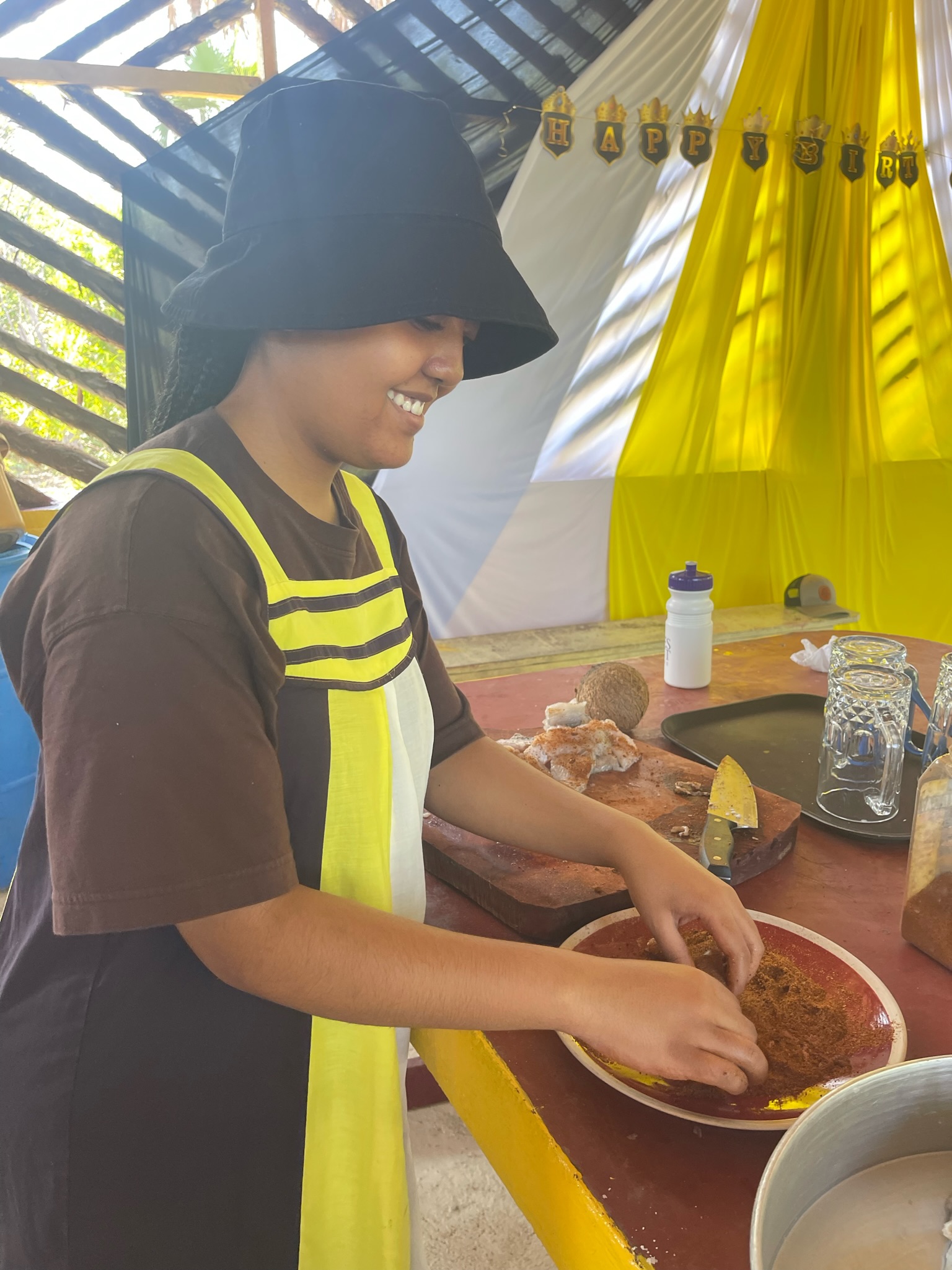
Jayla mashing the Plantains ‘Hudut’ and Naomi seasoning the Barracuda: Photos Provided by Anika

The last thing made for this dish was the sides. There were slices of barracuda rubbed in spices and some plantain tamales with a tomato and pork paste to go on top. These two really put the dish together as it added more to eat with the Hudut. This dish had a lot of hard work put into making and it correlated heavily with identity and globalization. When Uwhannie and her father mentioned this dish being used for weddings and celebrations, I thought a lot about how food is an essential part of the Garifuna community and their culture. Globalization can be seen when Hudut was made differently in other parts of Belize.

I could find similarities and differences within my own identity when we had our Hudut cooking class. A similarity I saw was when everyone put in the work to make this dish. Within my own family, everyone in the house would help my mom make the food she was cooking. If we wanted to have food on the table, we were expected to help out within the kitchen which led to a lot of bonding and overall good memories. A difference I saw within the Garifuna community and my identity was that they were more in tune with their culture and heritage. I had never learned about my own culture and heritage so it was an eye-opening experience to see how connected the Garifuna community was. I enjoyed my time at Palmento Grove and it was a very culturally opening experience. My next post will talk about Sabal’s farm and how they made Hudut using cassava.

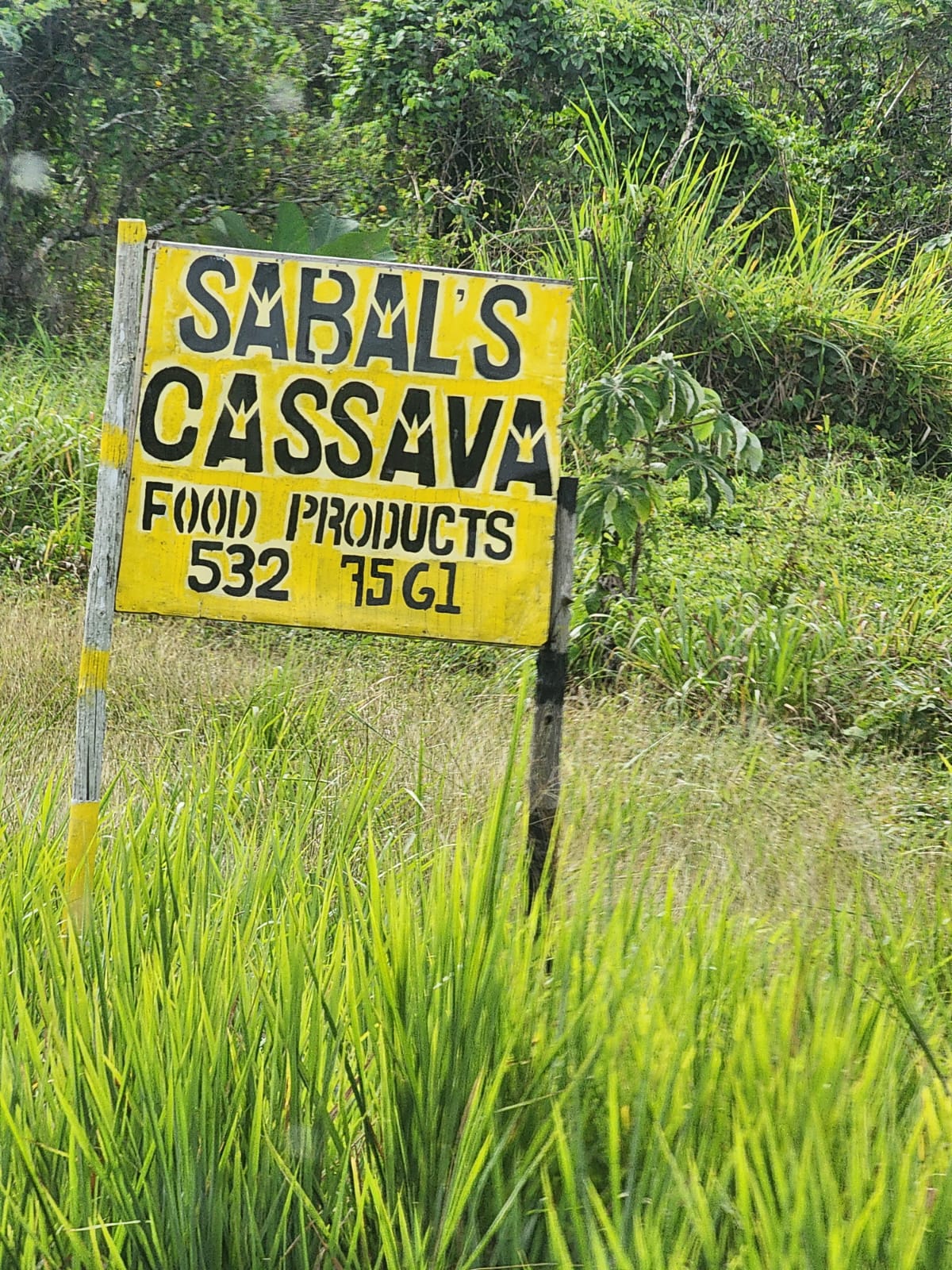
Journeys: Sabal’s Cassava Farm

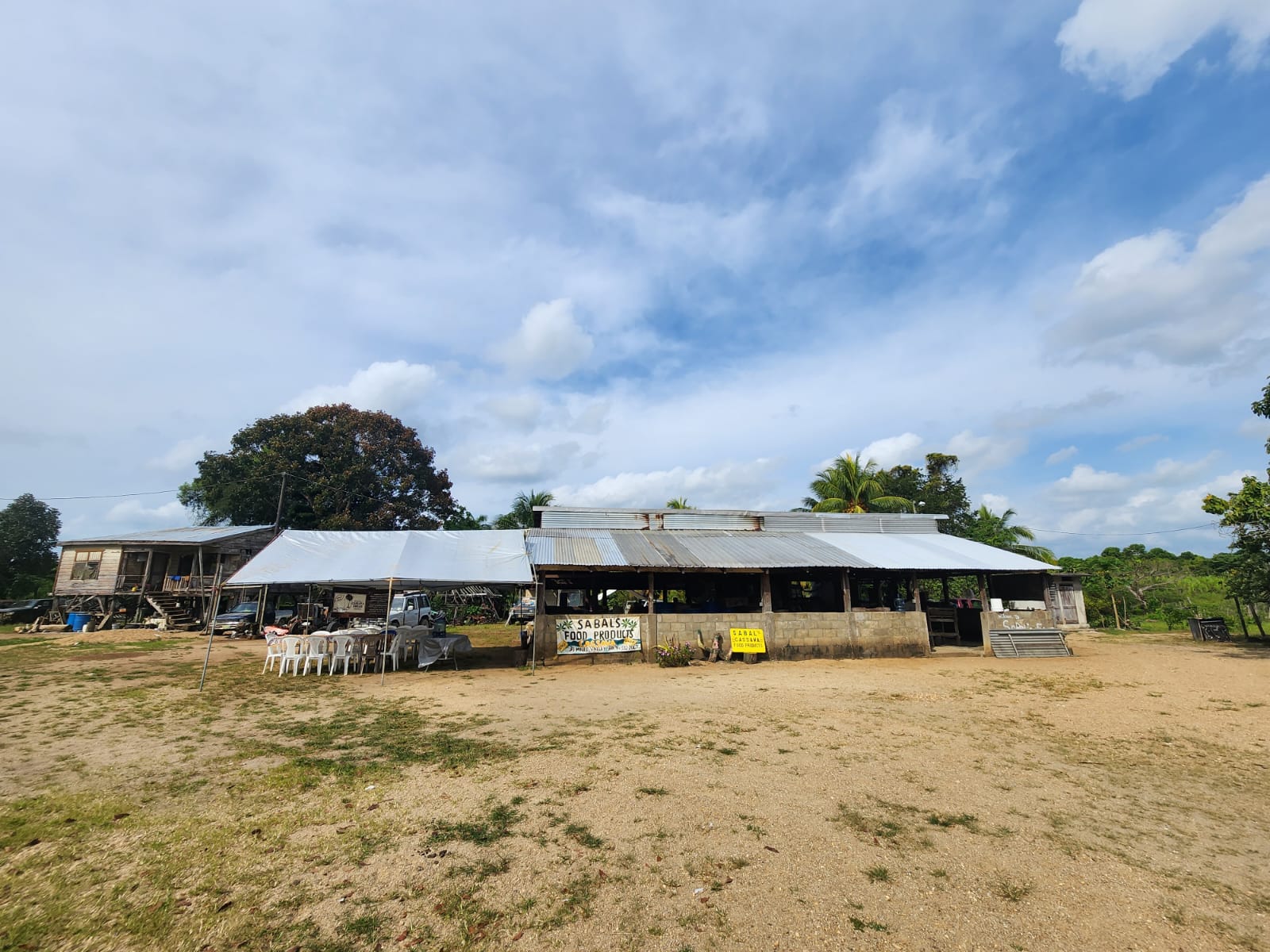
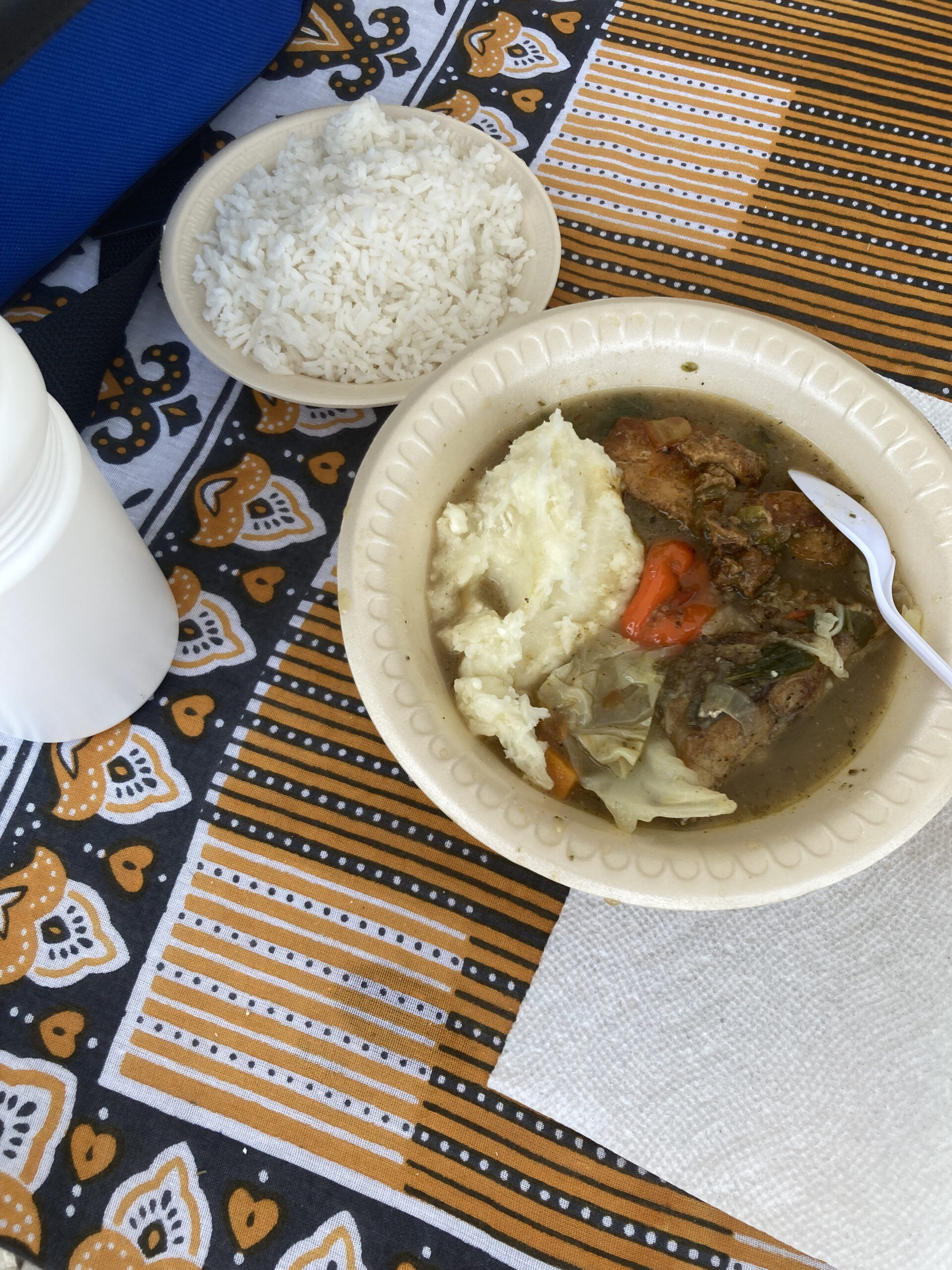
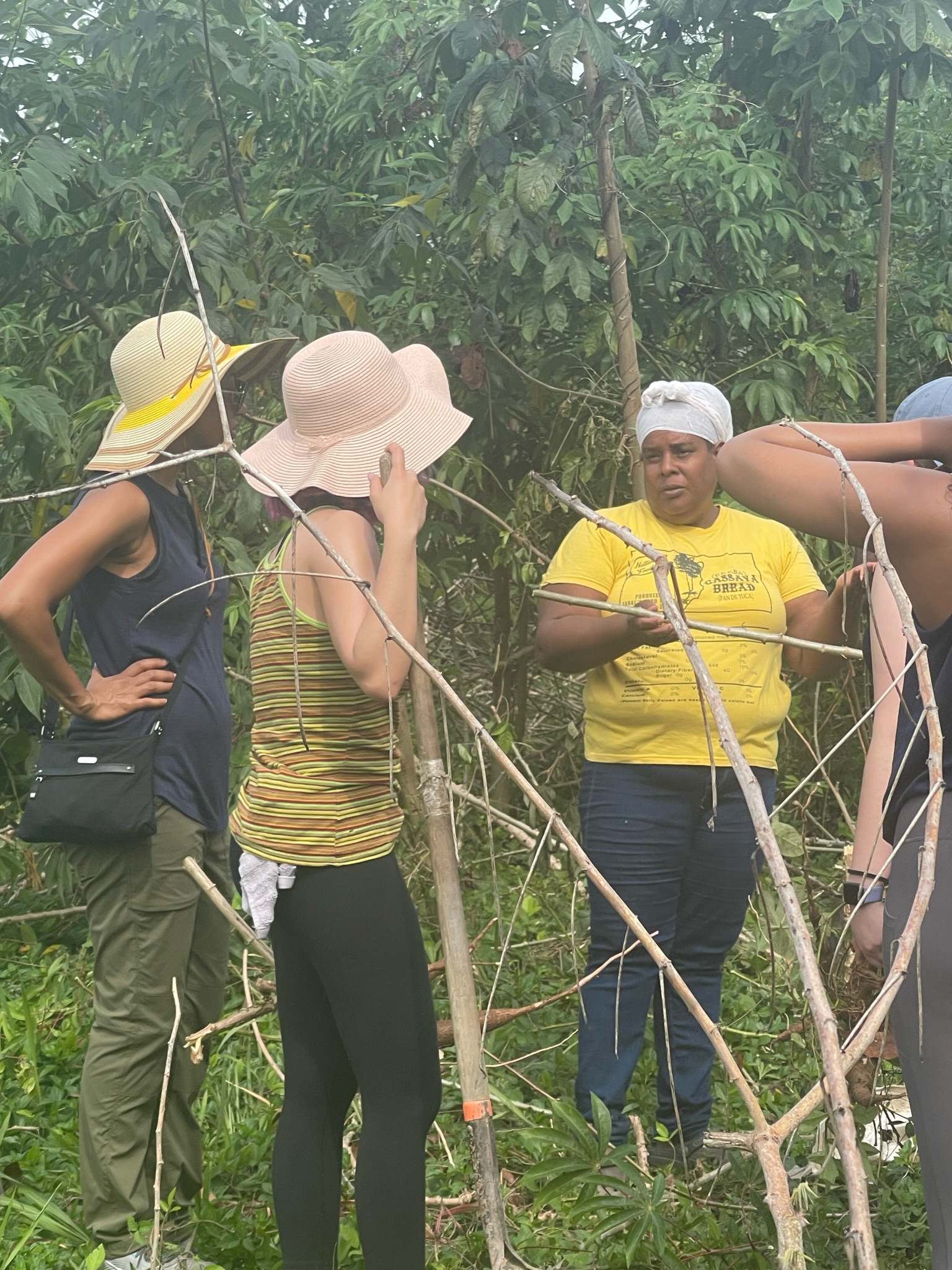
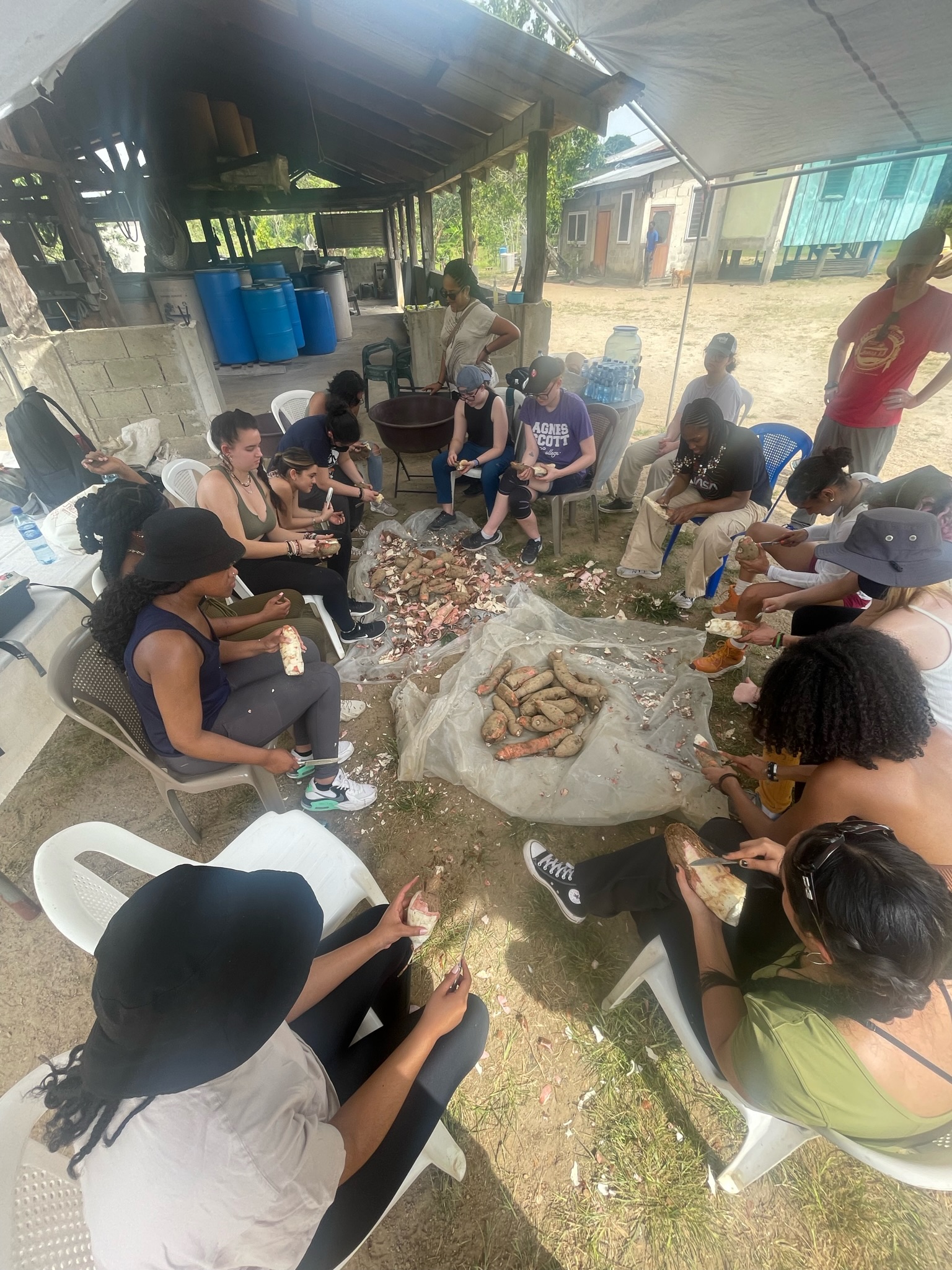
Sabal’s Farm and Hudut: Photos Provided by myself and the instructors

Our first task before making this dish was to collect the actual cassava/yuca roots. We ventured off into a farm area where lots of overgrown plants covered the area where the cassava was located. Some of us would first use machetes to clear the weeds and overgrown vegetation while others would pull back that vegetation. Once there was a root located, we would continue to pull back the weeds and plants to allow the individuals with the shovels to carve their way around the root. Once the root has a pathway carved, we would then pull it out of the ground to use for the next step.

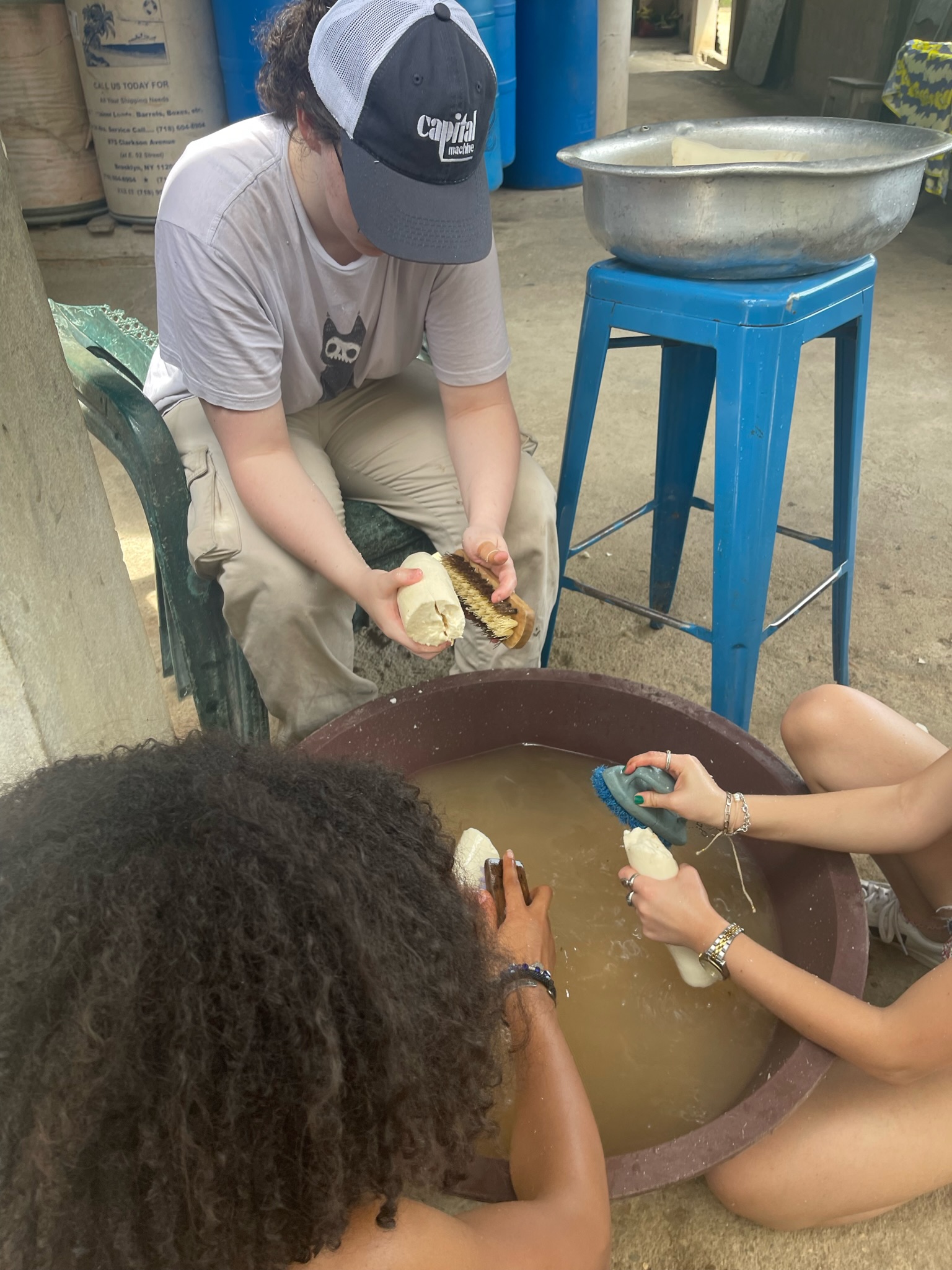
After we had collected enough roots, we then had to shave them with knives to allow them to be cleaned properly. I mainly started washing the roots because I had previously cut my thumb on accident when shaving them. The scrubbing was an arm-intensive activity as you had to scrape away any dirt and grime stuck to the roots. There were two types of roots used, bitter and sweet, both were used when preparing the Hudut dish.

This Hudut dish was different in the fact that everything was added to the stew instead of eaten separately. The Hudut was not made from plantains, instead, it was made from cassava instead. There were also other vegetables added to this broth along with beef and fish. To me, it was interesting to see how globalization could affect the making of a single dish within the same community. The people from Palmento Grove and the people from Sabal’s Farm are Garifuna and live within the same region of Belize, Hopkins. Globalization played a hand in the different aspects of creating a dish like Hudut from both of these families.

Cassava being dug up, shaved, and washed: Photos Provided by the instructors and Anika

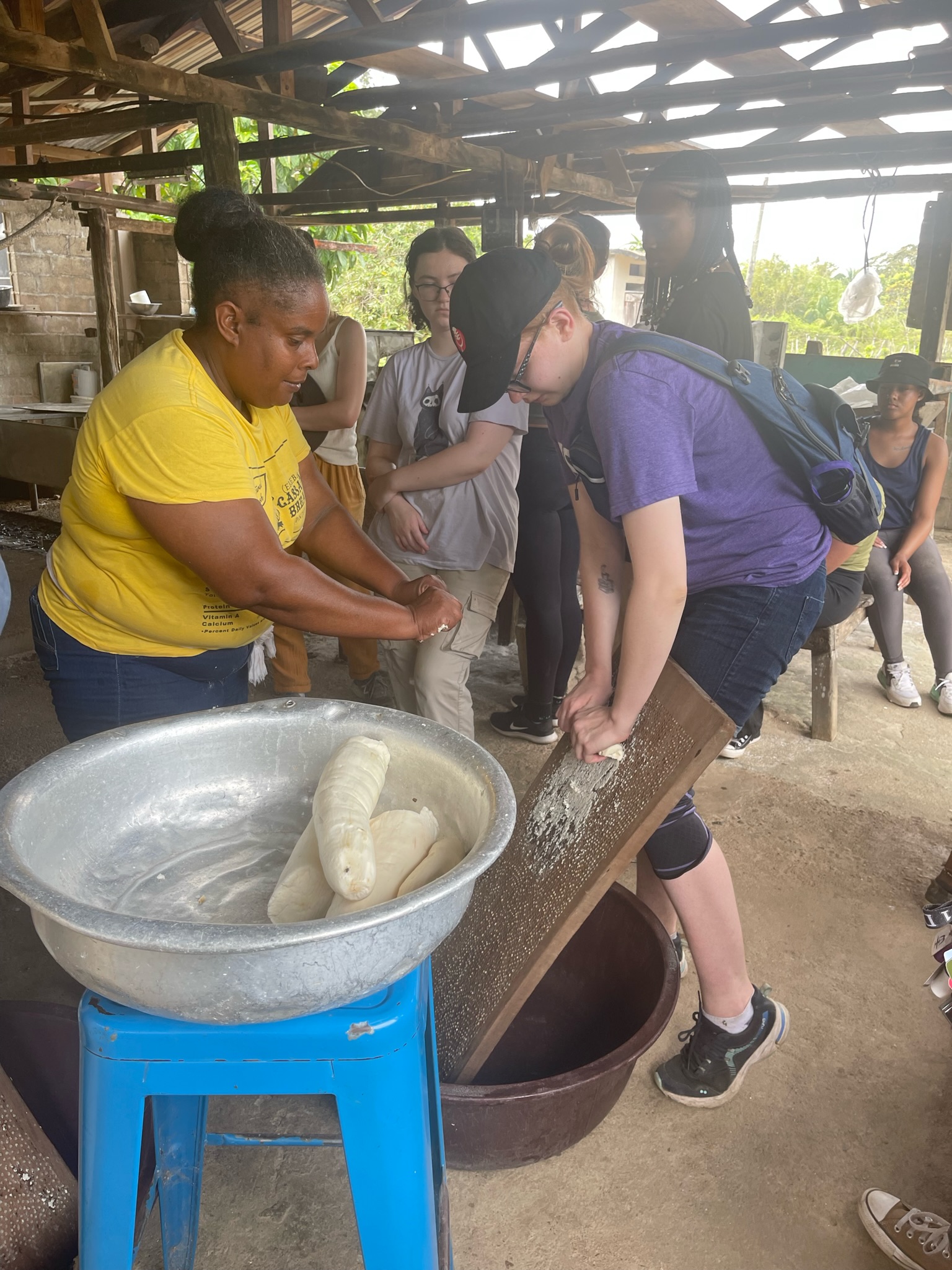
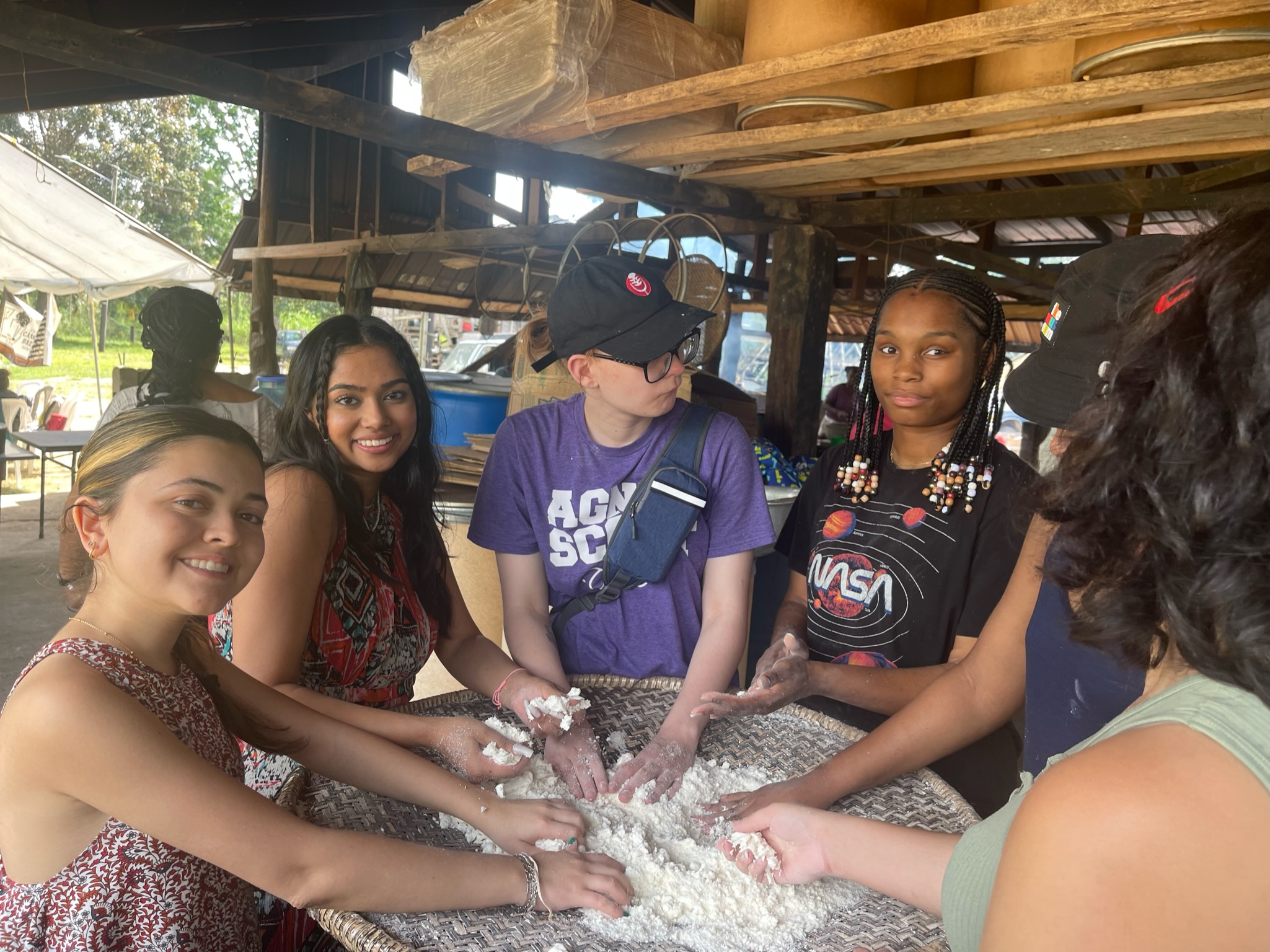
One major factor of the Sabal family’s identity is the machinery used when processing the cassava. Before the machinery was created by their grandfather, they had to grate and sift the cassava by hand. The items they used to grate the roots were a long washboard-like grater with small holes and a giant tub for the cassava to fall into. You had to use both hands and a forceful downward motion to scrape the root on the grater. The other process is sifting the hardened cassava grates into a fine powder. There was this giant, circular meshed mat where multiple people used their hands to rub the grated cassava into the mat. This created a fine powder which could then be used to make bread or flour.

Cassava being grated and sifted: Photos Provided by Anika and the instructors

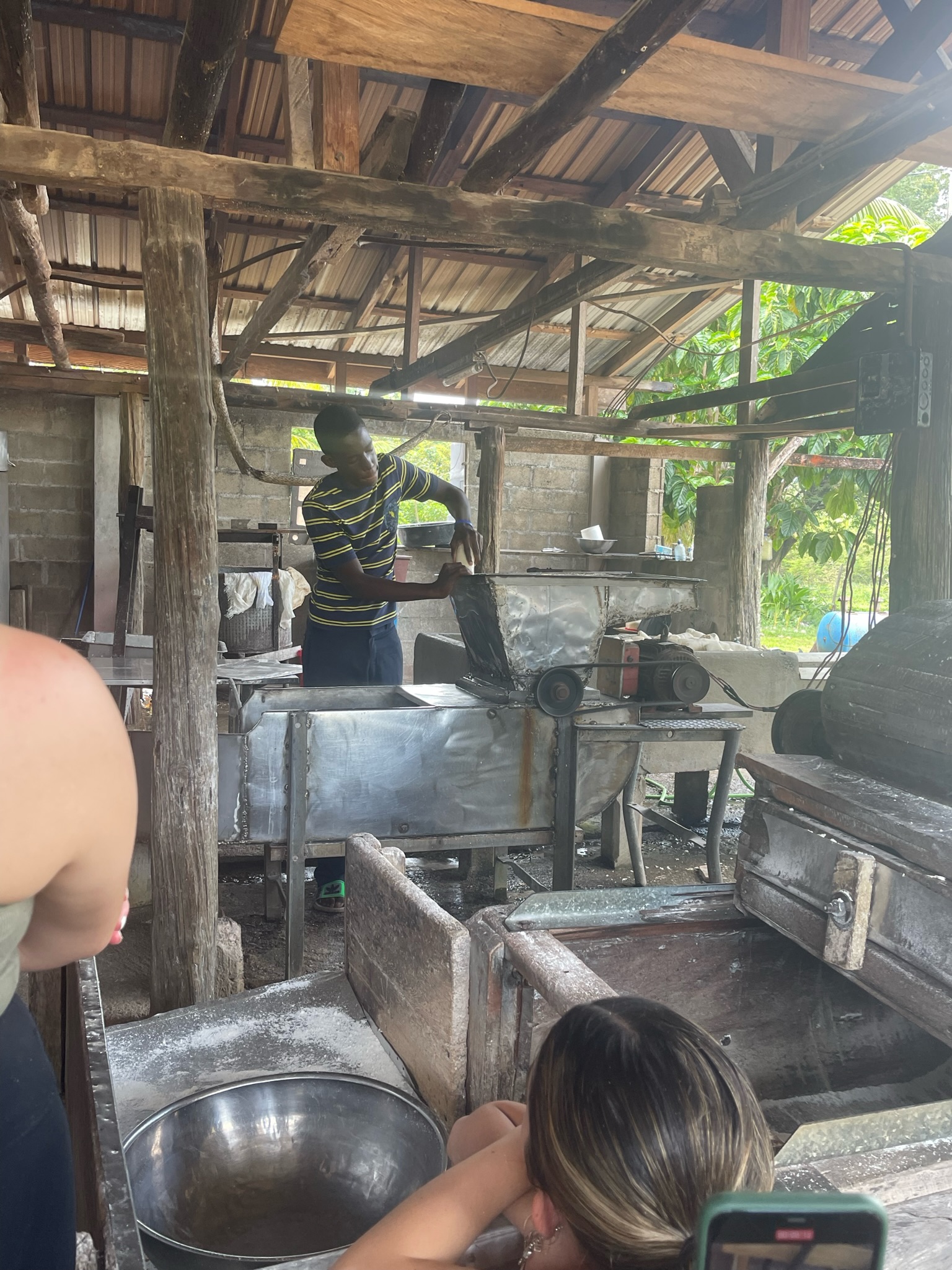
This process obviously took a good while to do especially under long hot days. This is why their grandfather created two machines used to help the process be faster and easier. They were both made of wood when they were first created but as time went on they had some improvements. The grinder is almost entirely made of metal sheets and while the sifter is majorly made of wood, it is still exceedingly functional. They kept it this way to honor their grandfather and to keep his memory alive. His machinery made exceptional progress in their farm’s cassava products and is an essential part of their identity and culture.

New machines for Cassava: Photo Provided by Anika

The topic of family seems to be one of the major things that contribute to Garifuna’s identity. A lot of techniques for making cassava are passed down throughout generations. Sabal’s Farm is family run so it is incredibly important that the newer generations know how to make Cassava and run the business.

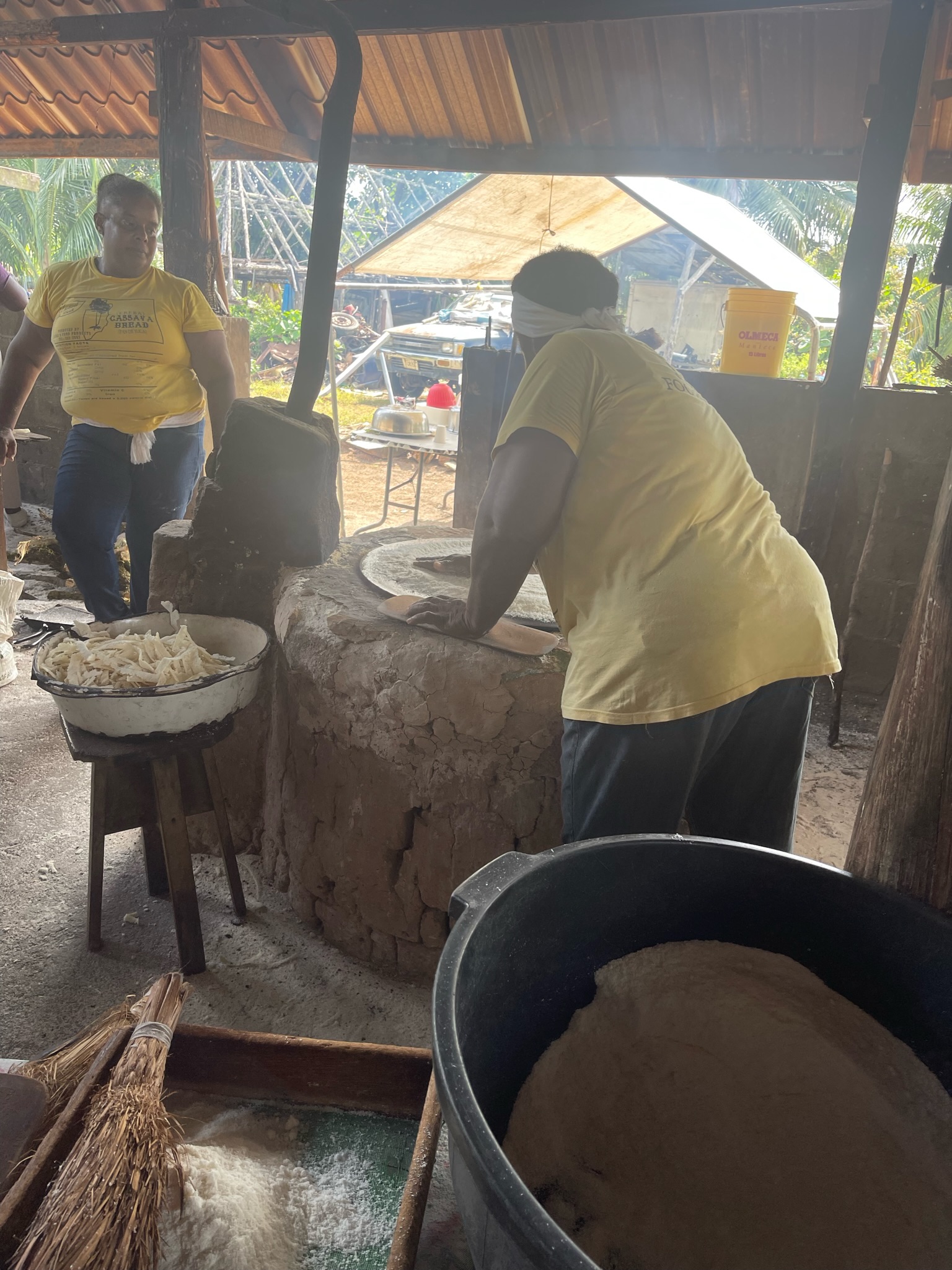
One of the last things we saw during our experience at Sabal’s Farm was to see our guide’s mother making cassava bread.

Cassava bread being baked: Photo Provided by Anika

The bread-making process was not an easy task yet it seemed to be second nature to our guide’s mother. Her process was spreading fine-grained cassava, carving the edges, pressing the bread and the grain to the stove, and flipping the bread for an even cook. She has a lot of experience and knowledge in cooking cassava bread. That experience and knowledge will someday be passed down so the newer generations will learn the cassava-making process. This passing down of knowledge contributes to their identity as cassava-making is a big part of their culture. Newer generations knowing how to make cassava bread also contributes to the globalization of Sabal’s products. When more people know about Sabal’s farm, more people will want to go there and get cassava-based products. It also provides an opportunity for people to learn about this side of the Garifuna culture.

Journeys: Mayan Chocolate and Tortilla-Making

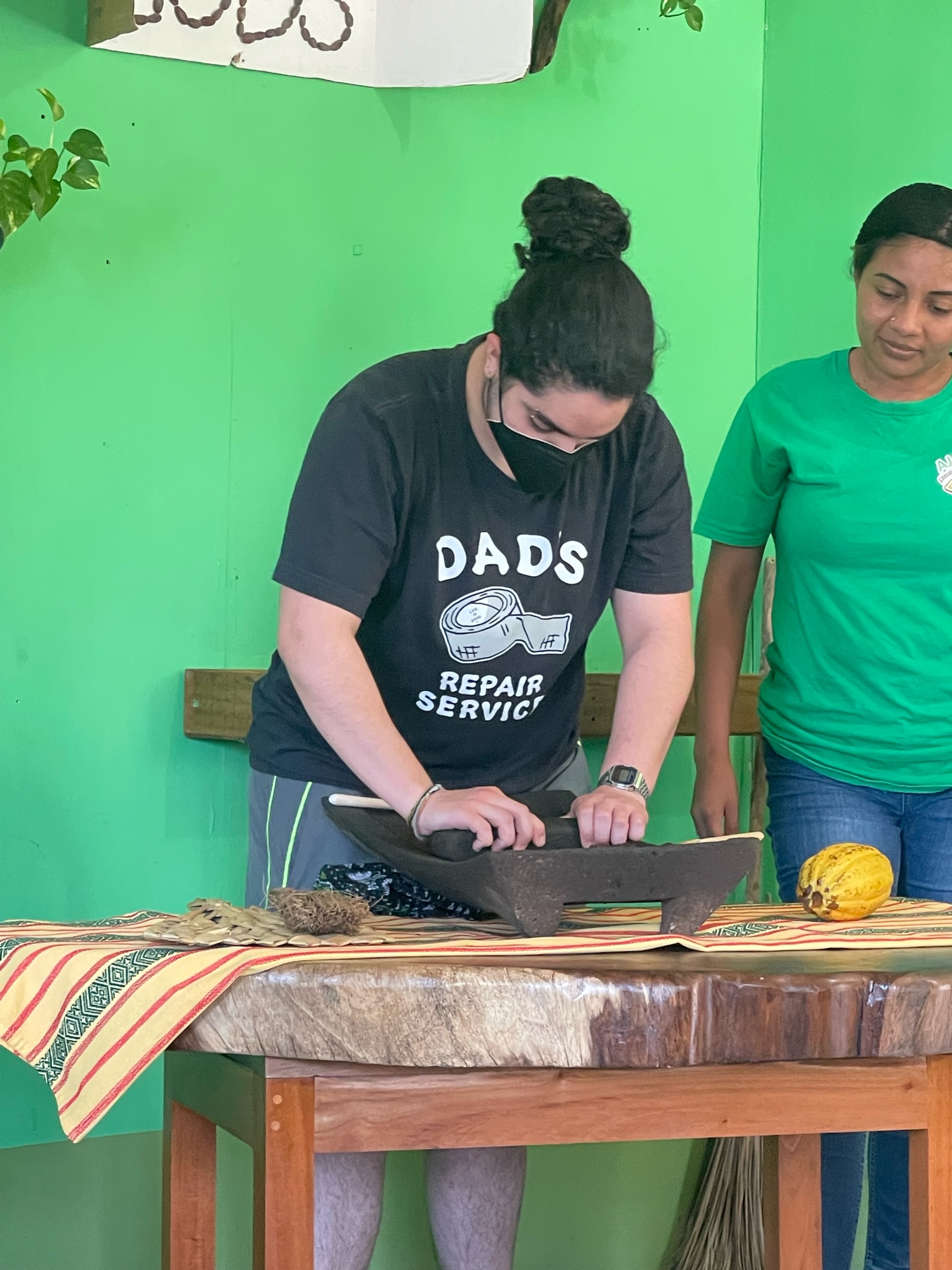
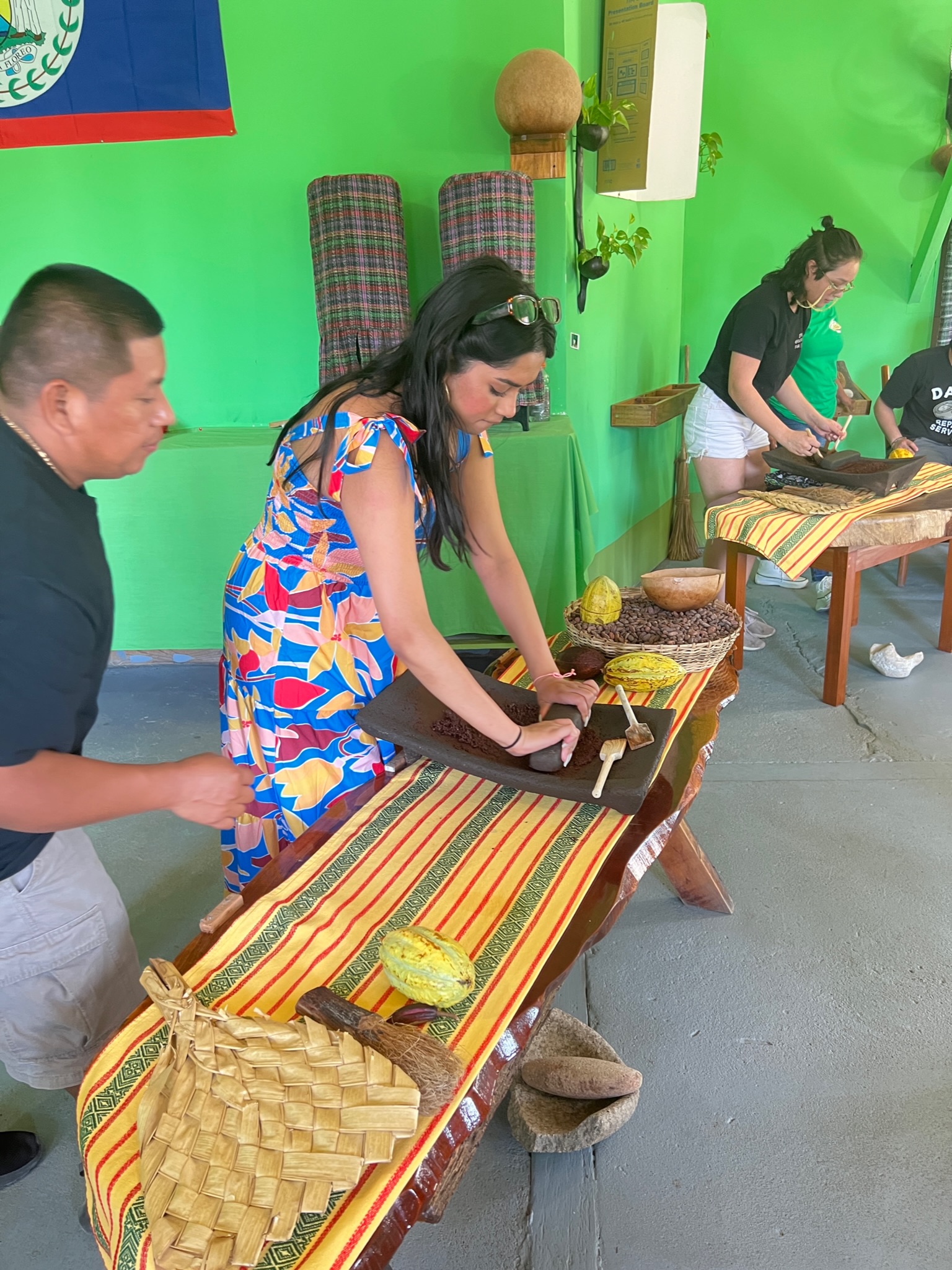
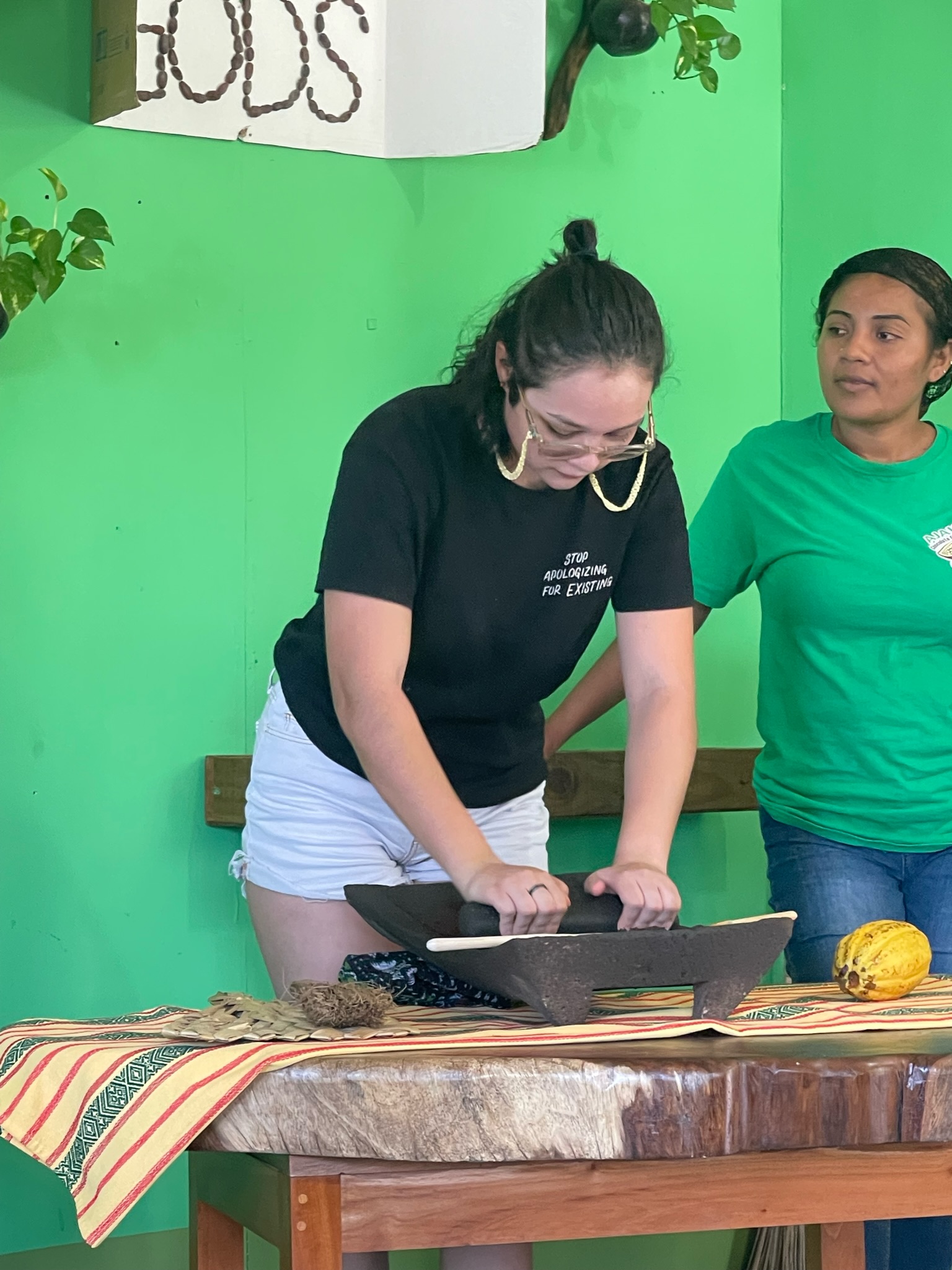
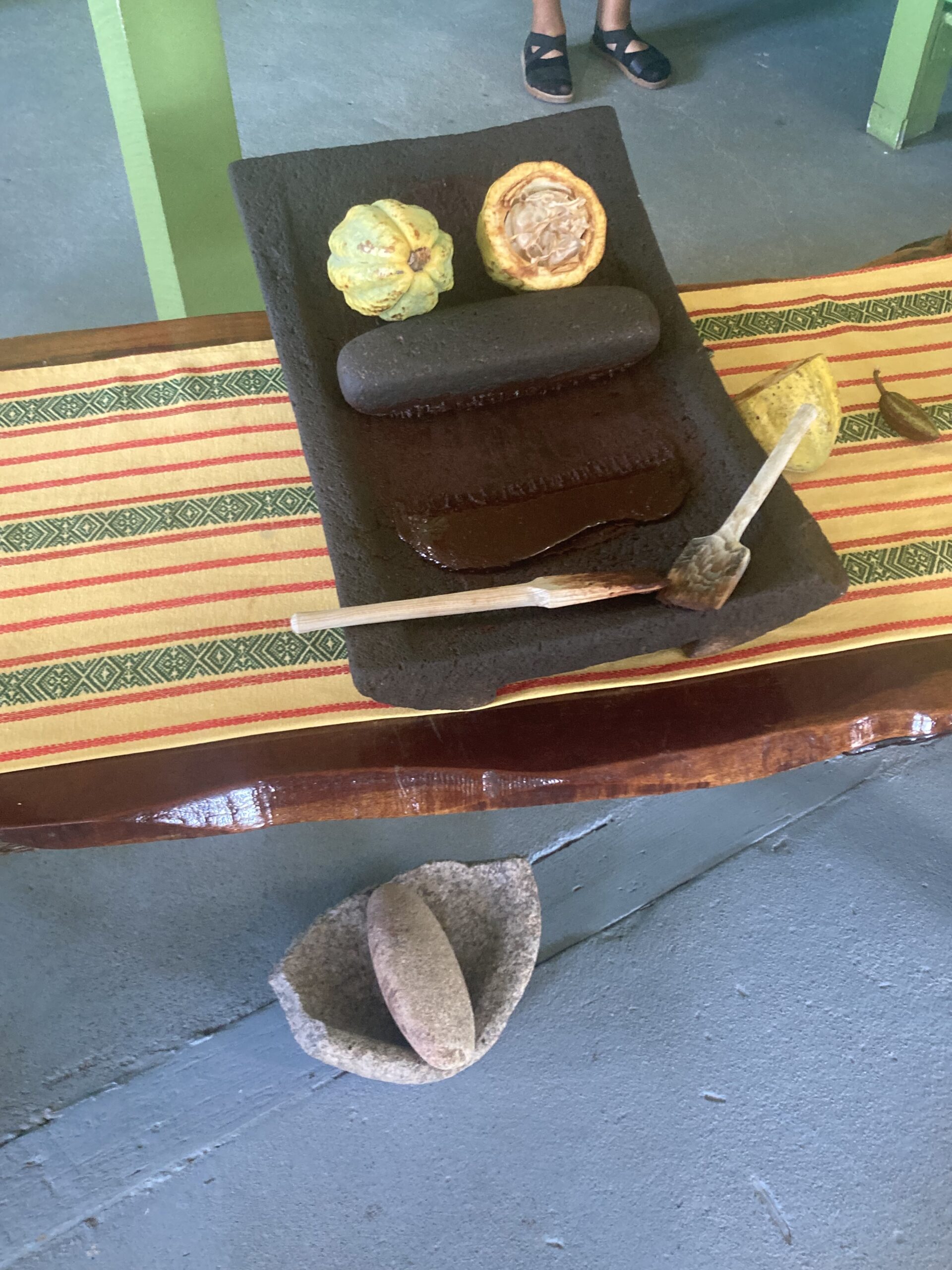
Annabelle, Anika, and Olivia grinding cocoa beans to a paste: Photos Provided by Anika

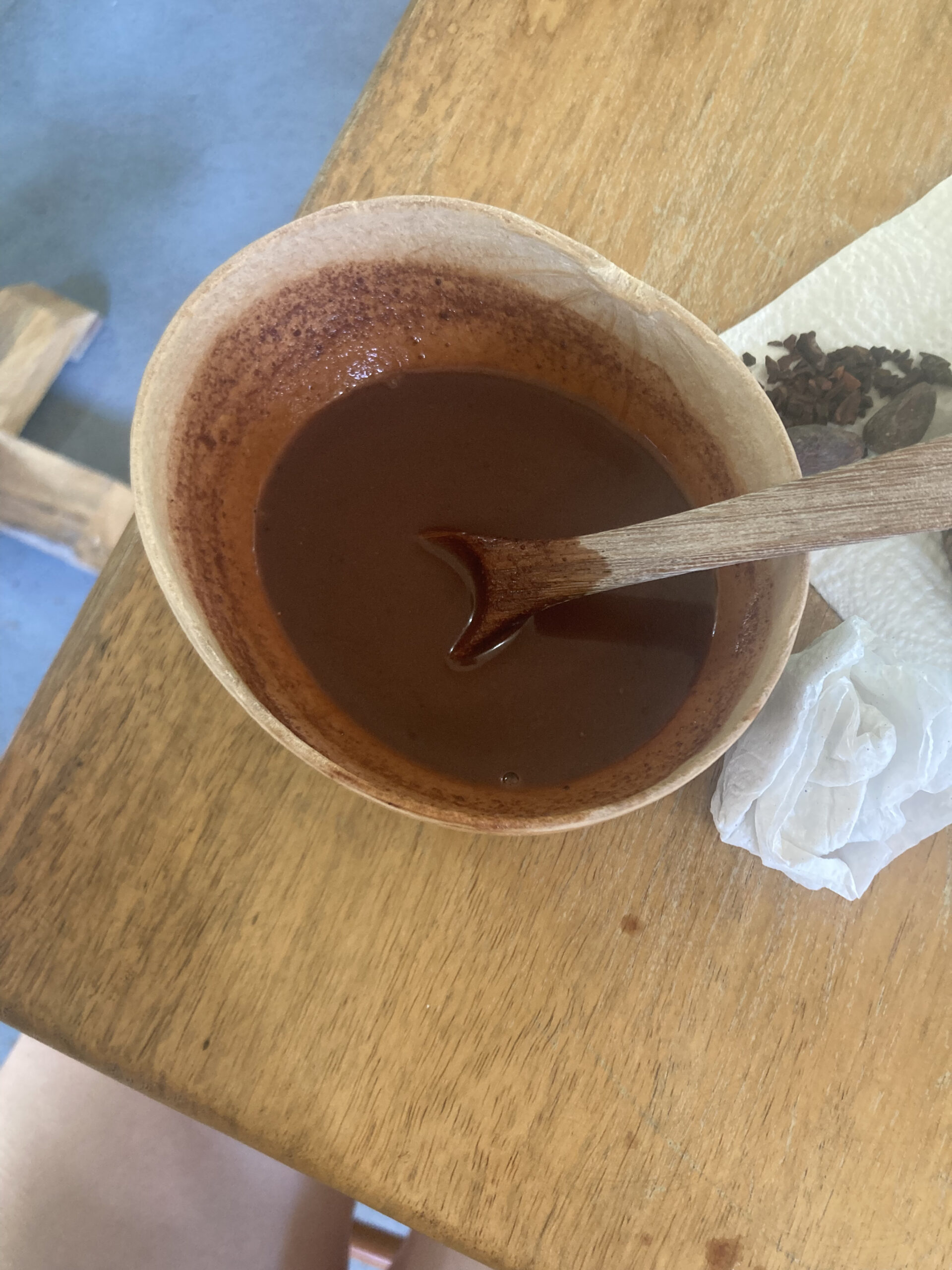
On our fourth day, we went to a chocolate-making workshop where we got the experience to know what Mayan chocolate is and how important it was to Mayan culture. We first had a look at the breakdown of what the cacao plant was made of. The main ingredient used to make chocolate is the cocoa bean which is the seed inside the cacao plant. That seed would then be ground into a paste, mixed with water, and served as a chocolate drink. This chocolate drink is significant for their identity as it is used for special occasions.

Chocolate grinder with the cacao and chocolate mix: Photo Provided by me

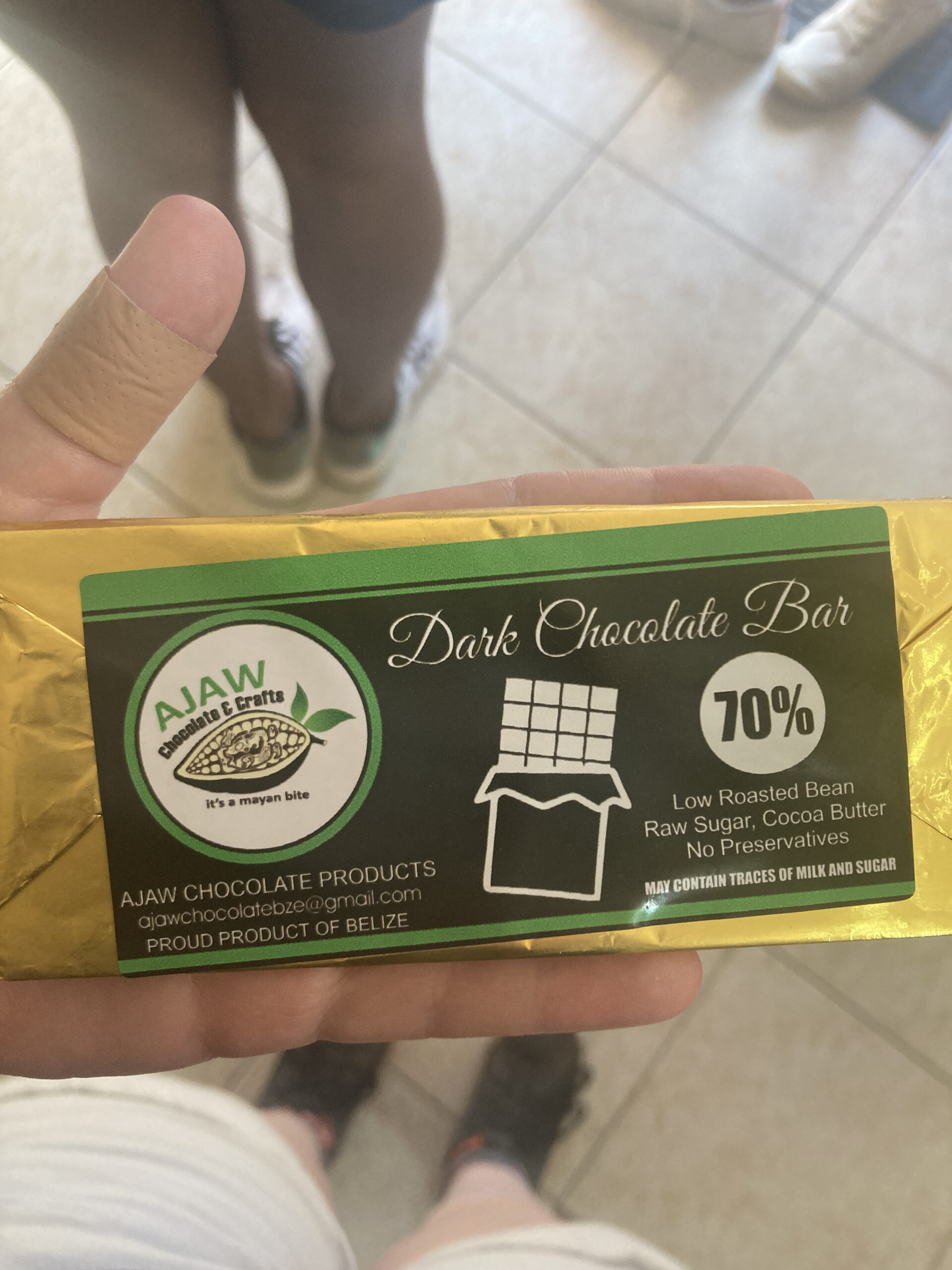
The one aspect that people don’t realize when talking about chocolate coming from Mayans is that it is extremely bitter. The original way of making chocolate is to not add sugar. Instead, other spices like cinnamon, anise, chili, etc are added. Milk is also not added to making Mayan chocolate as the Mayans are lactose intolerant. Mayans like having their chocolate straight from the plant, some even eat cocoa beans. Our chocolate instructor mentioned how their chocolate bars are only made with 3 ingredients. Cacao, cocoa butter, and cane sugar.

Mayan chocolate bar: Photo Provided by me

Now you see I mentioned they didn’t add sugar to their chocolate to keep its richness. Due to the influx of tourists and Western influence, they are having to sweeten their chocolate to please international individuals. They are having to go against what they believe to be something deeply rooted in their culture to please Westerners. He even made a joke saying that in a few years, they will have to start making milk chocolate.

There was a bit of sadness to that, or at least that was how I interpreted the “joke.” This is his life and it’s essentially important to his Mayan culture. To think that globalization and the influence of other countries would impact his culture this much makes me wonder how long will it take before they completely have to stop making their traditional chocolate. It reminded me of the things we read in class to prepare for our journey. The topics talked about in our readings heavily discussed colonization, globalism, and identity. In the film, The Last Tourist, tourism had been unintentionally destroying the environment they came to see. The locals that do live there barely get any of the benefits that tourism offers. A lot of the money tourists spend in these destinations goes to tourist companies and businesses connected with the tourist industry.

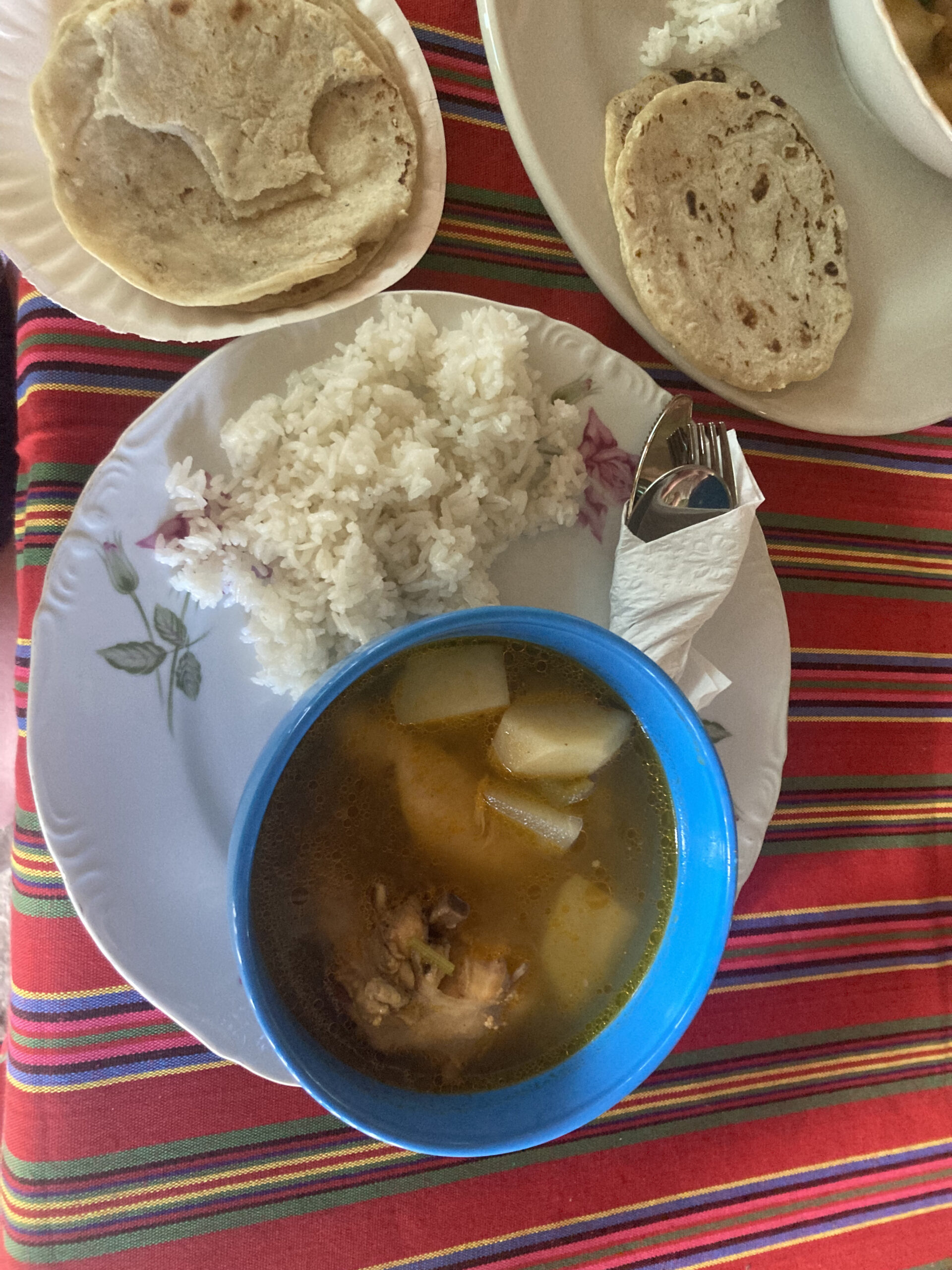
Chicken Soup: Photo Provided by me
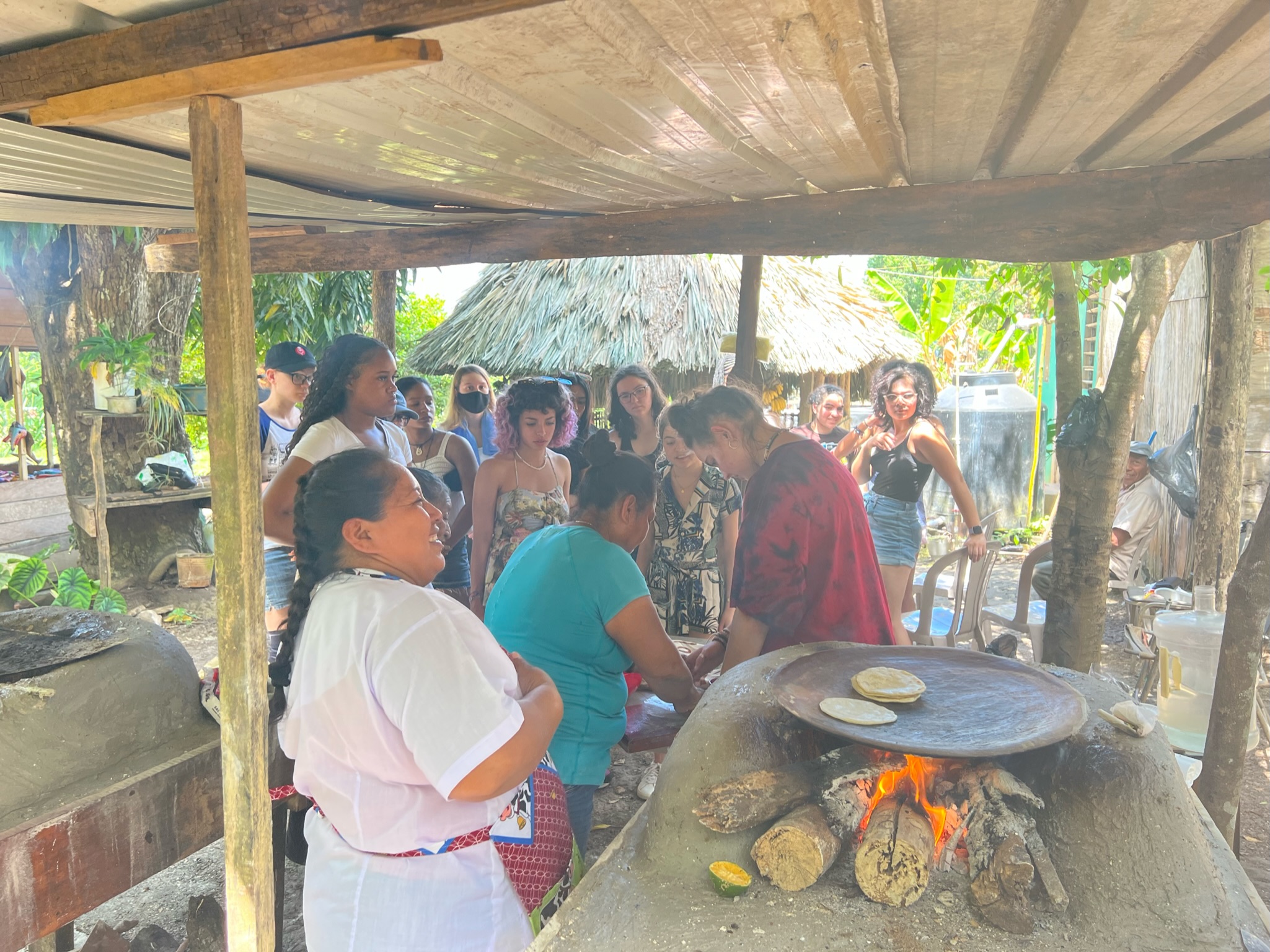
Group shaping and cooking tortillas: Photo Provided by instructors

Upon day 5, our Xunantunich tour guide, Joseph, took my group and me to a traditional tortilla-making class with Mayan ladies. When we first arrived they showed us where they cooked the tortillas and how they shaped them. Tortilla-making is an important part of their culture and identity as much of the food they eat involves tortillas. 

This experience reminded me of my own family. When I talked about the Garifuna and how we put in all of our efforts in making Hudut, it reminded me of my own family. Tortilla making is a lot similar to what my family and I make. It was really nostalgic to see as it brought back how my siblings would help my mother make tacos, tamales, Spanish rice, etc. My little sibling was especially good at making the taco dough by hand. Everyone cooking in the kitchen also reminded me how all of the recipes we have came from my grandmother and my great-grandparents. This process was also similar to how older generations in the Mayan and Garifuna community would pass down recipes and cooking techniques to newer generations.

One particular dish I ate while I was there was chicken soup. Inside the soup was chicken, potato, chicken broth, and different spices. They also had pork that could be added to the tortillas we made earlier. One of the women also mentioned the process of fermenting the mean (mainly pork) before using it in any of the dishes they made. This process usually takes a few days and it’s another aspect of their culture and identity.

Another part of visiting these Mayan ladies was that they had a small business where they sold homemade jewelry and dolls. I noticed a lot of the selling of homemade goods throughout Belize. This was most prominent within the areas where the Mayan community resided most. These stalls were there because a lot of the Belizeans don’t earn enough to sustain themselves. One man I came across after our Xunantunich tour was selling pictures of different animals made from deceased butterfly wings. He mentioned that his son made them and everything he makes would go to his son’s education. It just goes to show that although tourism brings in money, it doesn’t necessarily always go to the individuals and families that need that money.

To conclude, this experience has been unforgettable. I learned a lot about other cultures as well as myself. I was able to eat food that had important cultural meaning to the communities that offered to share it. I was also able to take back the impacts globalization such as international influence, economic travel, and tourism had on a country like Belize. I was very appreciative to be on this experience and I felt I could make deeper connections with myself and with the communities we interacted with. 

Final Progress Post 4/21

This is a progress post for my Visual Art Final

I currently have the final project completed as of April 21st, 2023. The topic I chose for this project is “greatest fear.” My greatest fear has always been a failure. Failure in relationships, failure in friendships, failure in academics, failure in myself, etc. This fear of failure is overwhelming some days. That is where the first drawing on the left comes in. This piece is supposed to capture the overwhelming feeling of failure and how it pulls at me. I wanted all 3 of these pieces to interconnect. I used the stretching of the skin of the drawing on the left to connect with the middle piece and the morphing of the house on the right to connect too. The middle piece is representative of what it feels like when the fear of failure gets too overwhelming. It feels as if my head is bursting from the amount of pressure put on it. The figures in the back are the beings looking over me. They are the embodiment of my failure, they look down on me and keep the pressure on me. The drawing on the right is the origin of where I believed I started to develop this fear of failure. It is the house that holds a lot of memories from my childhood that contributed to my fear of failure.

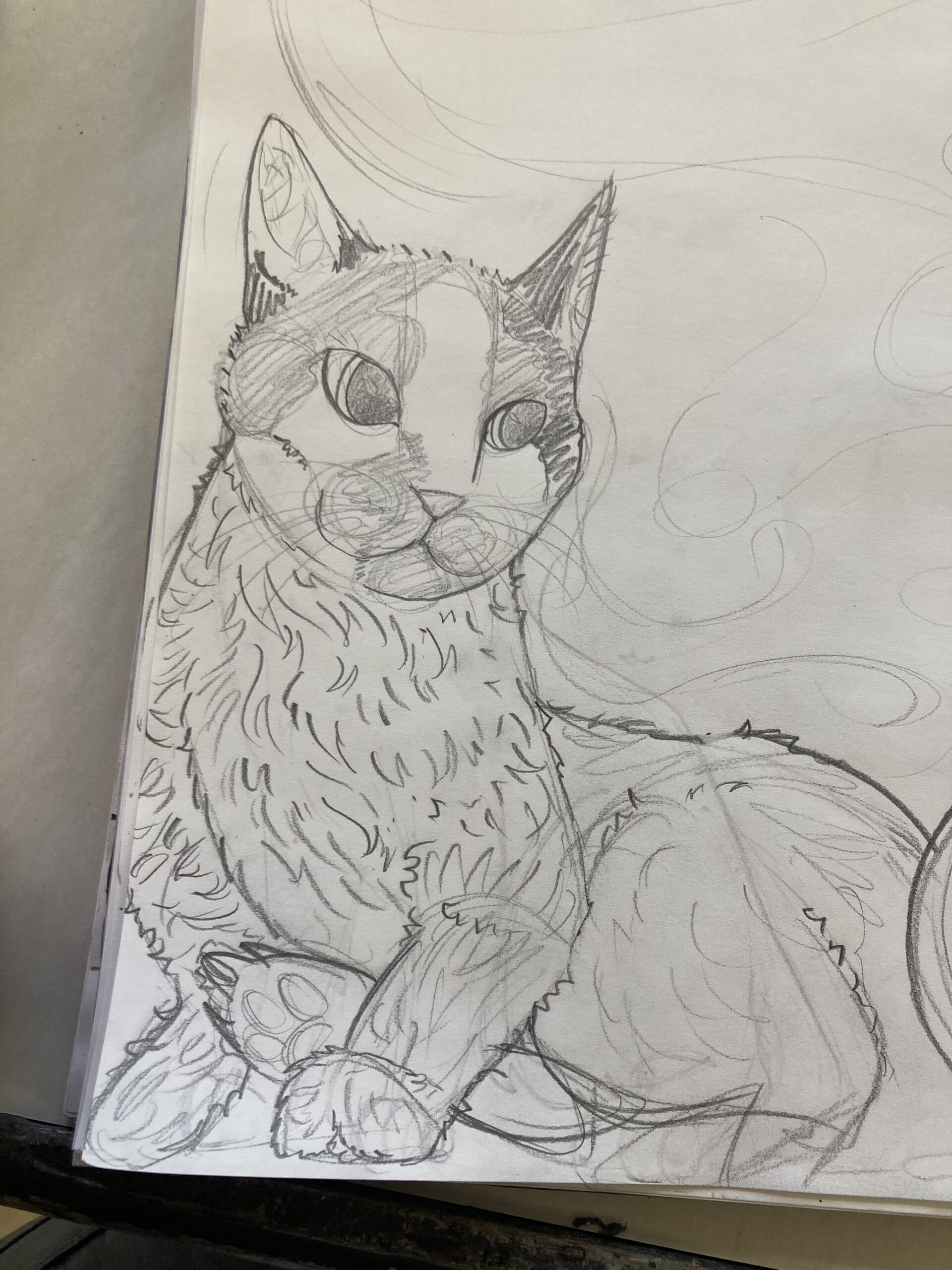
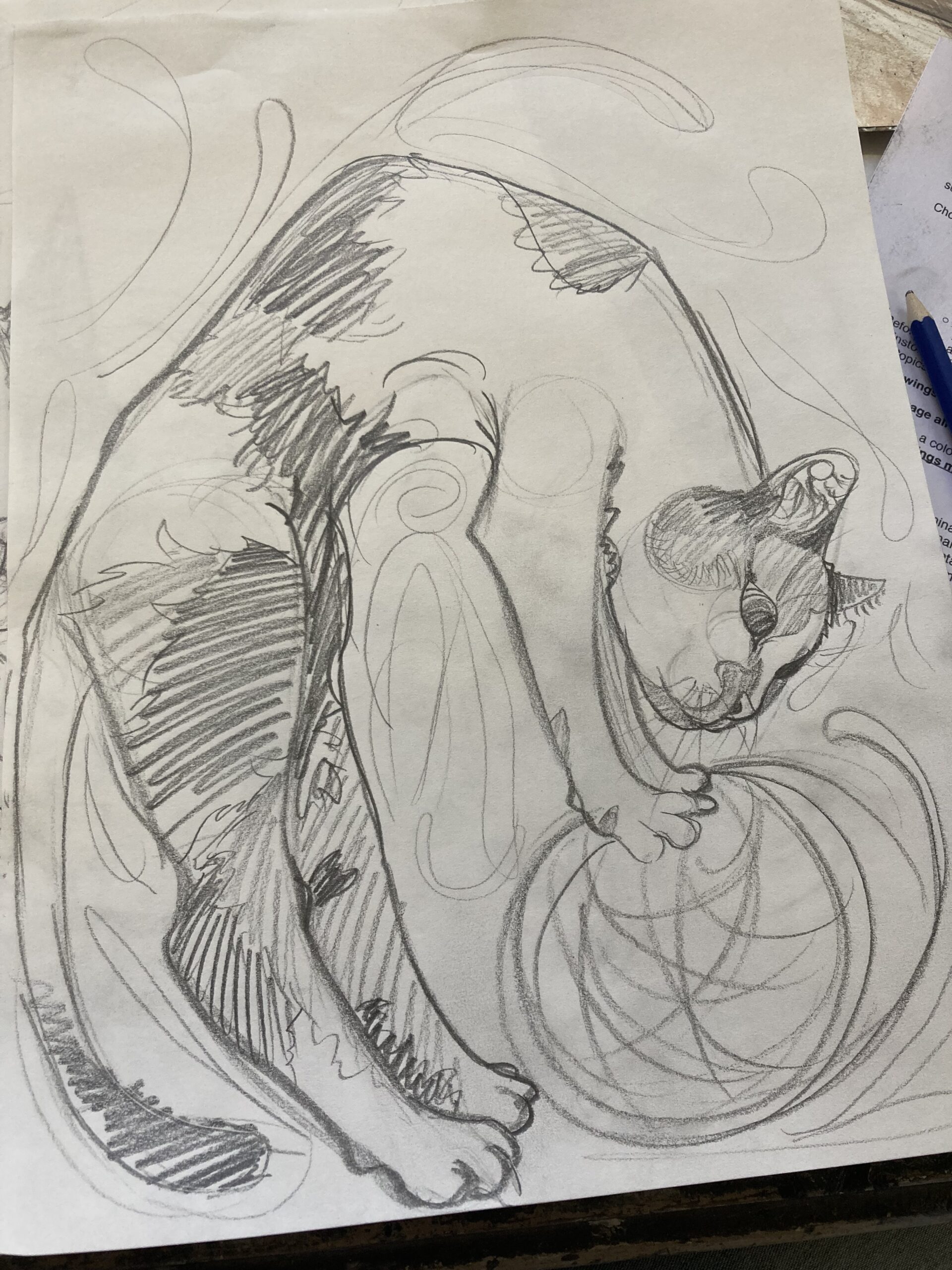
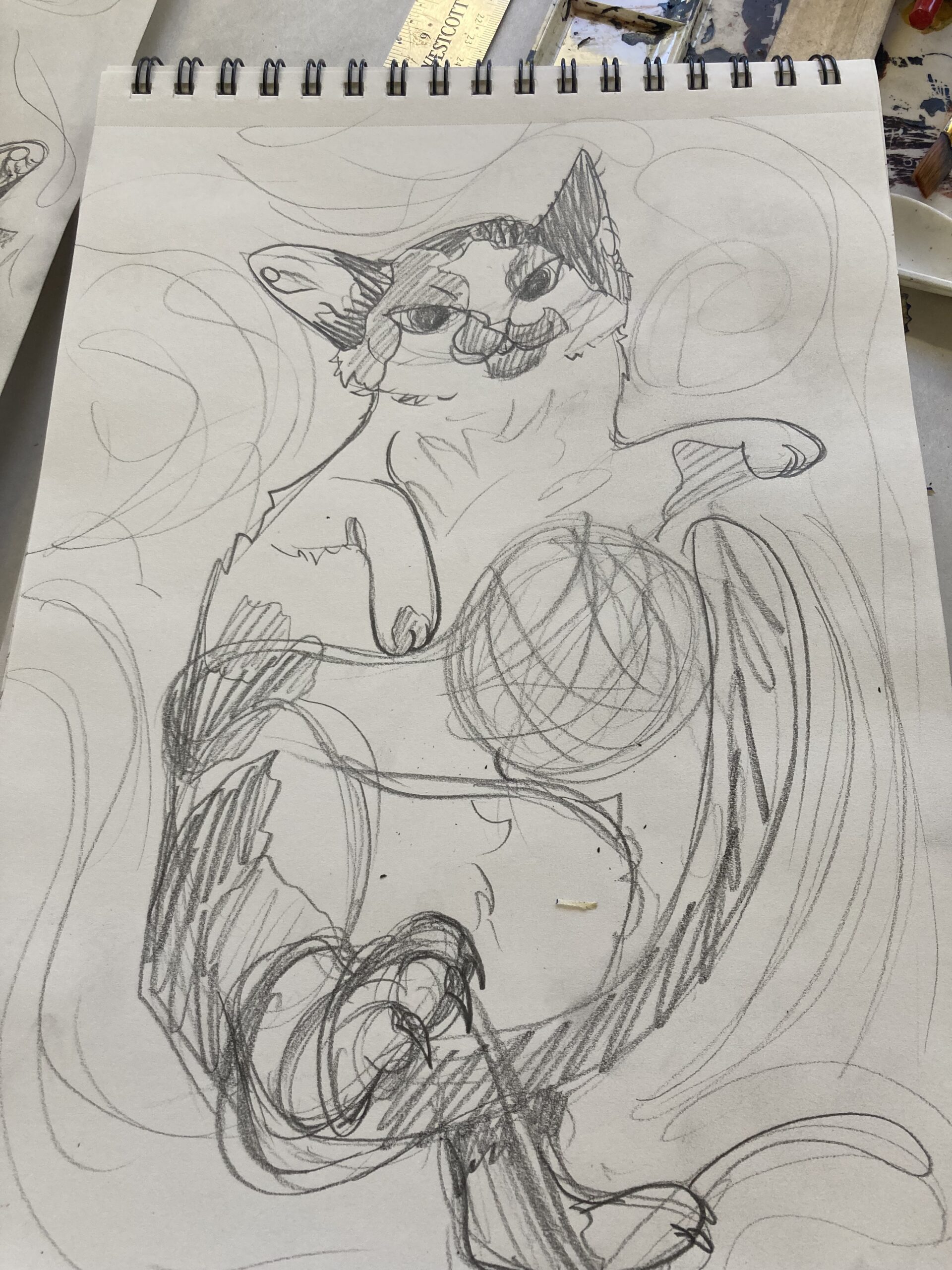
At the beginning stages of the drawing process, I didn’t have a clear thought as to what I wanted to do. Once I was able to sketch it down I was able to get through this project fairly easily. I enjoyed this prompt a lot and I actually started a different prompt with the sequence as the main focus. I used my cat as the main focus for this and I depicted her chasing a ball of yarn.

I wanted to show a lot of movement with this project as well. I might not finish it as I hope but I do plan on using a lot more bright colors for this one. I wanted to contrast the color palette for this collection of three in comparison to the 3 I already finished. I also decided to use more watercolors for the drawings with my cat rather than the inks I used for the biggest fear drawings.

To conclude, my final project is already finished as of this point. I had taken a lot of time and effort to bring to life the envisionment of my biggest fear. I enjoyed the making process of this project and I am happy that I was able to make a second one. My cat is one of the most important things in my life so making my second one about her brings me a lot of inspiration.
Art Mid-Term: Texture

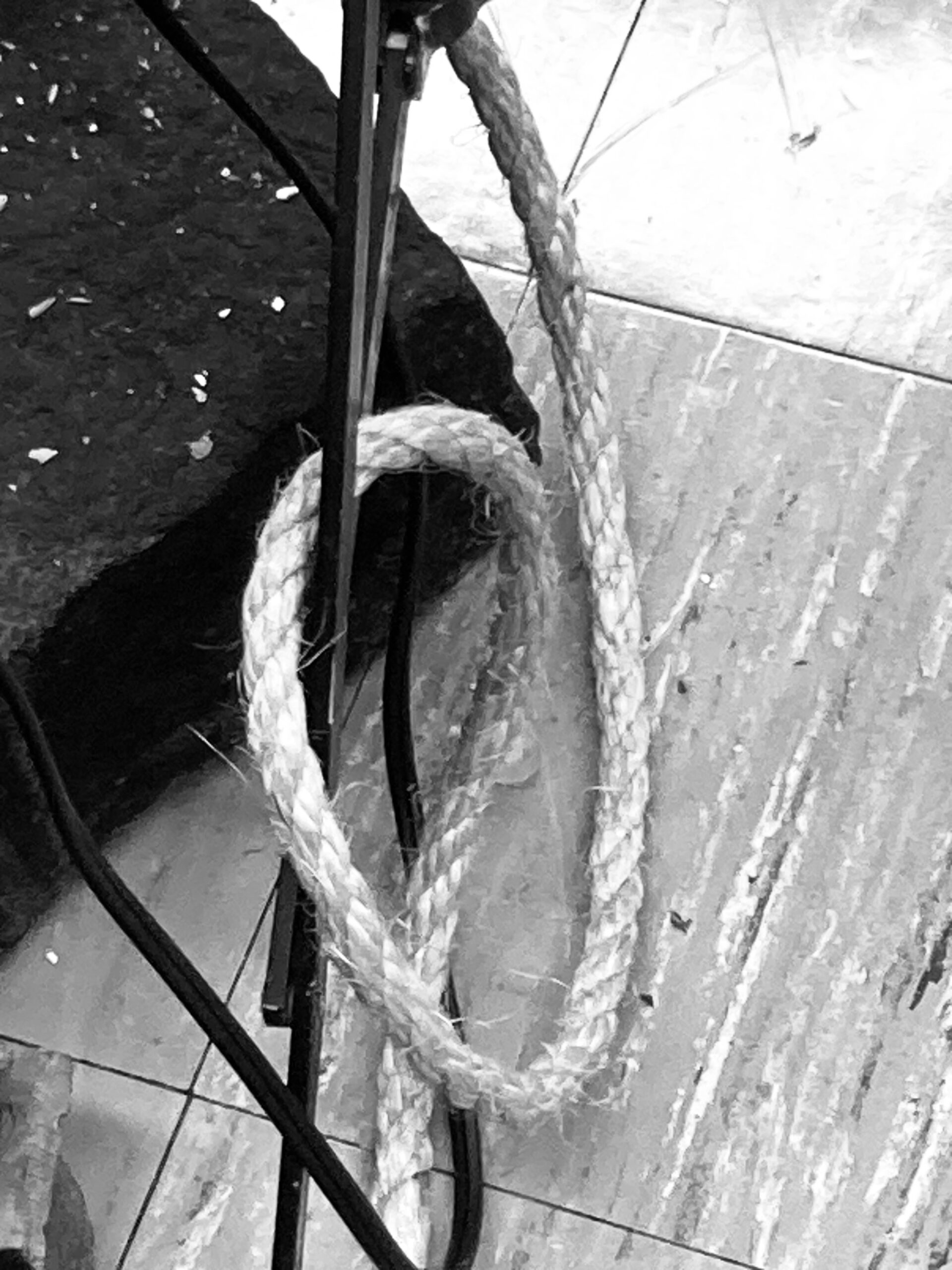
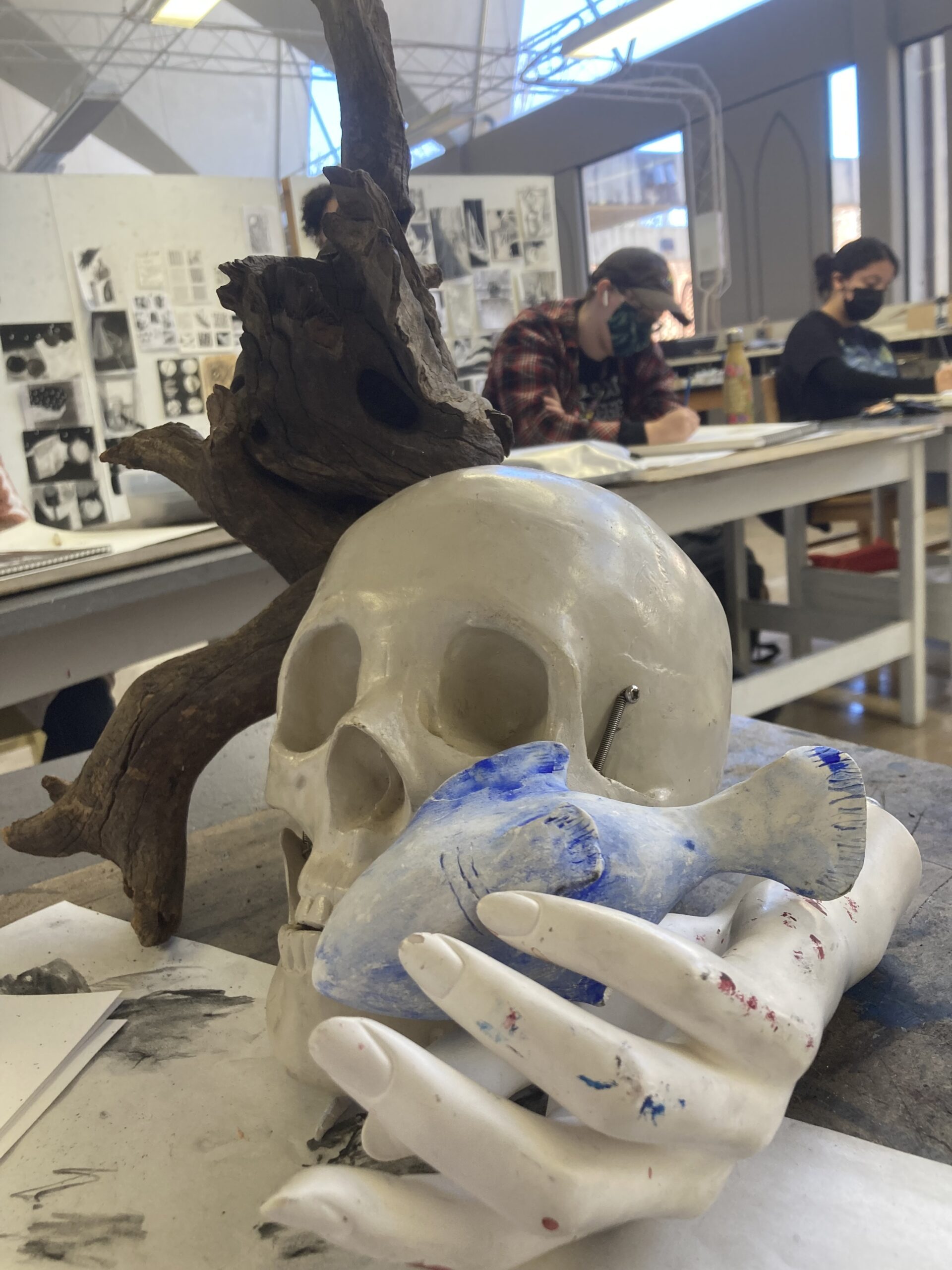
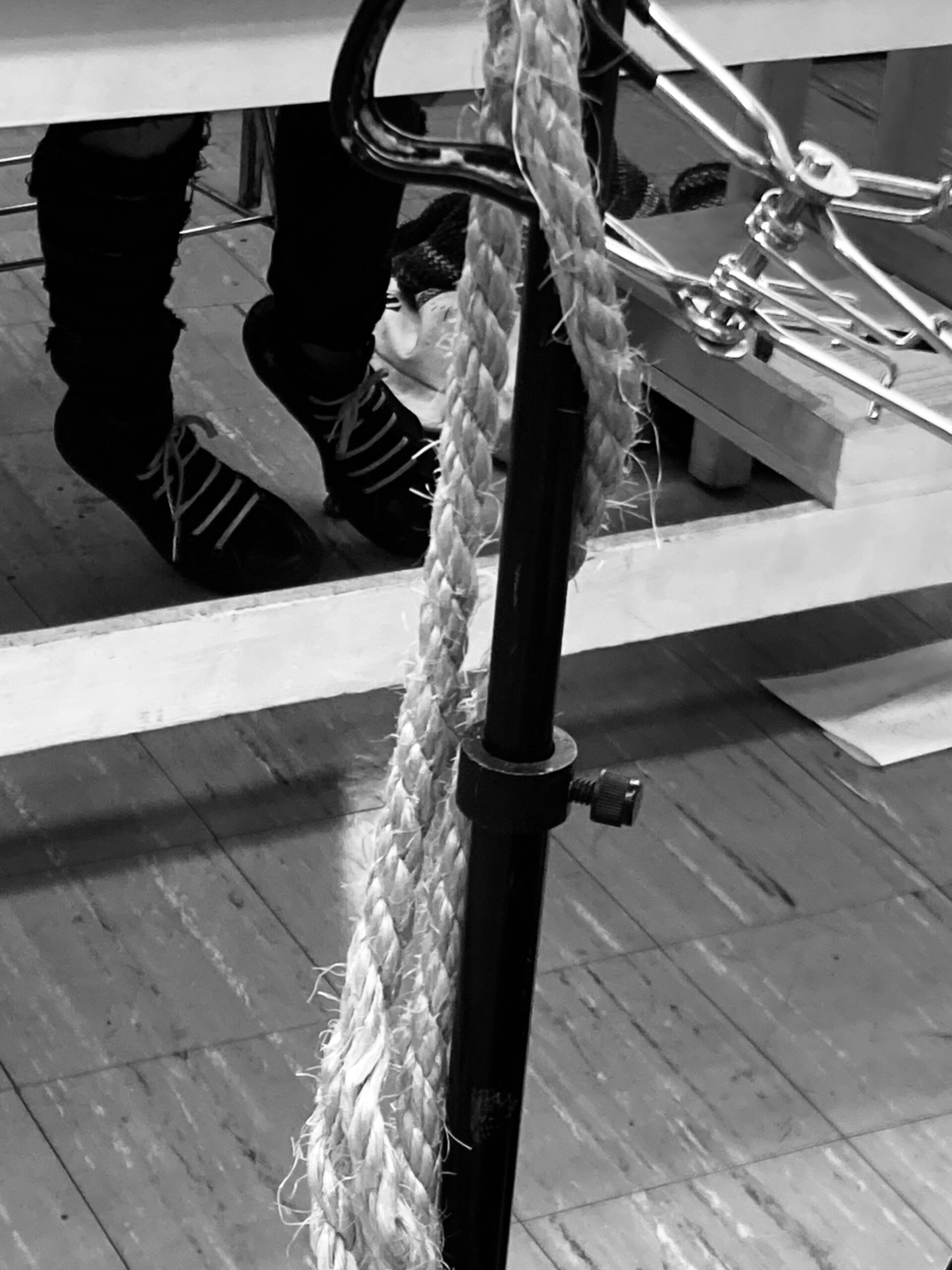
Reference Photos

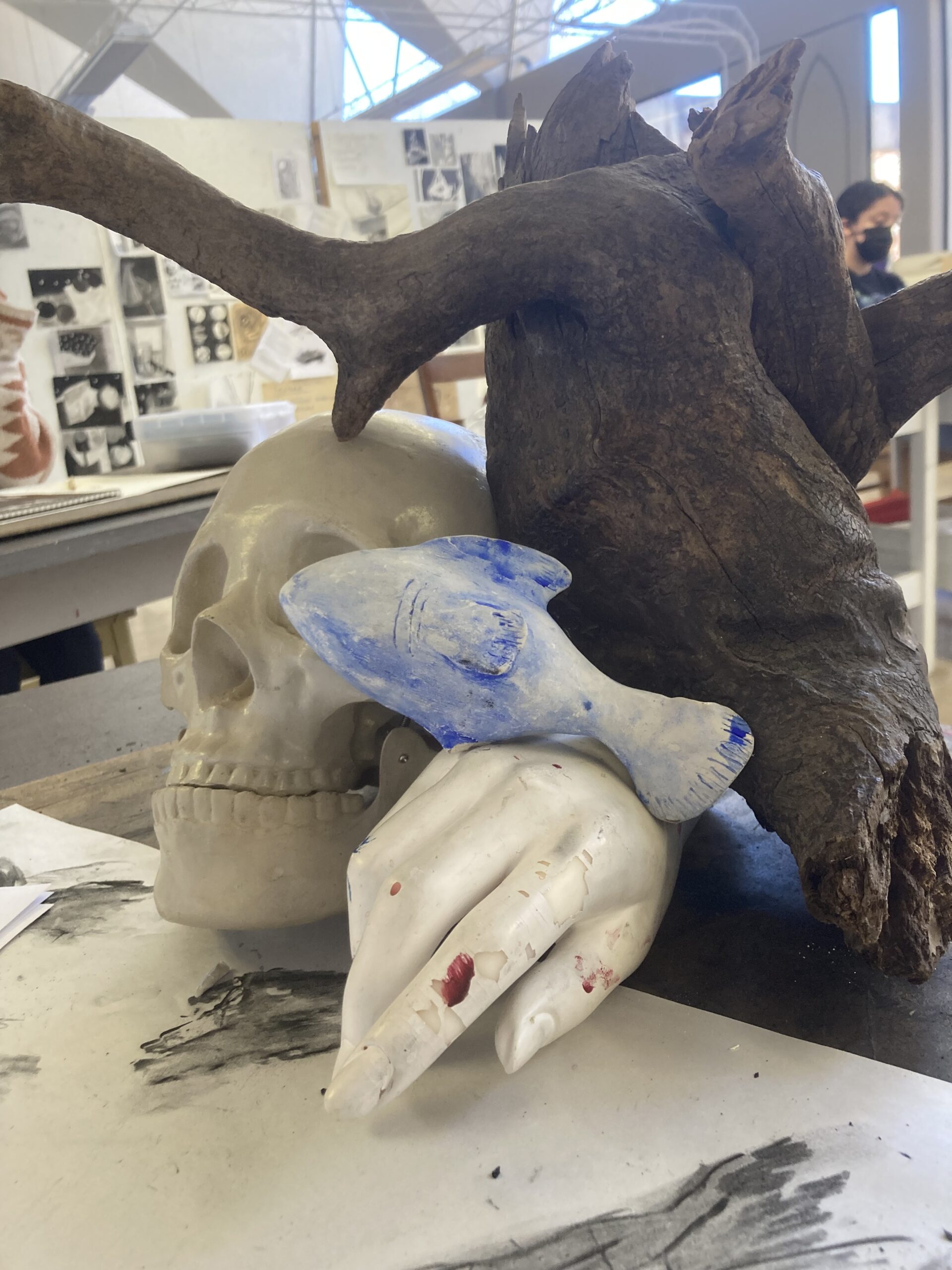
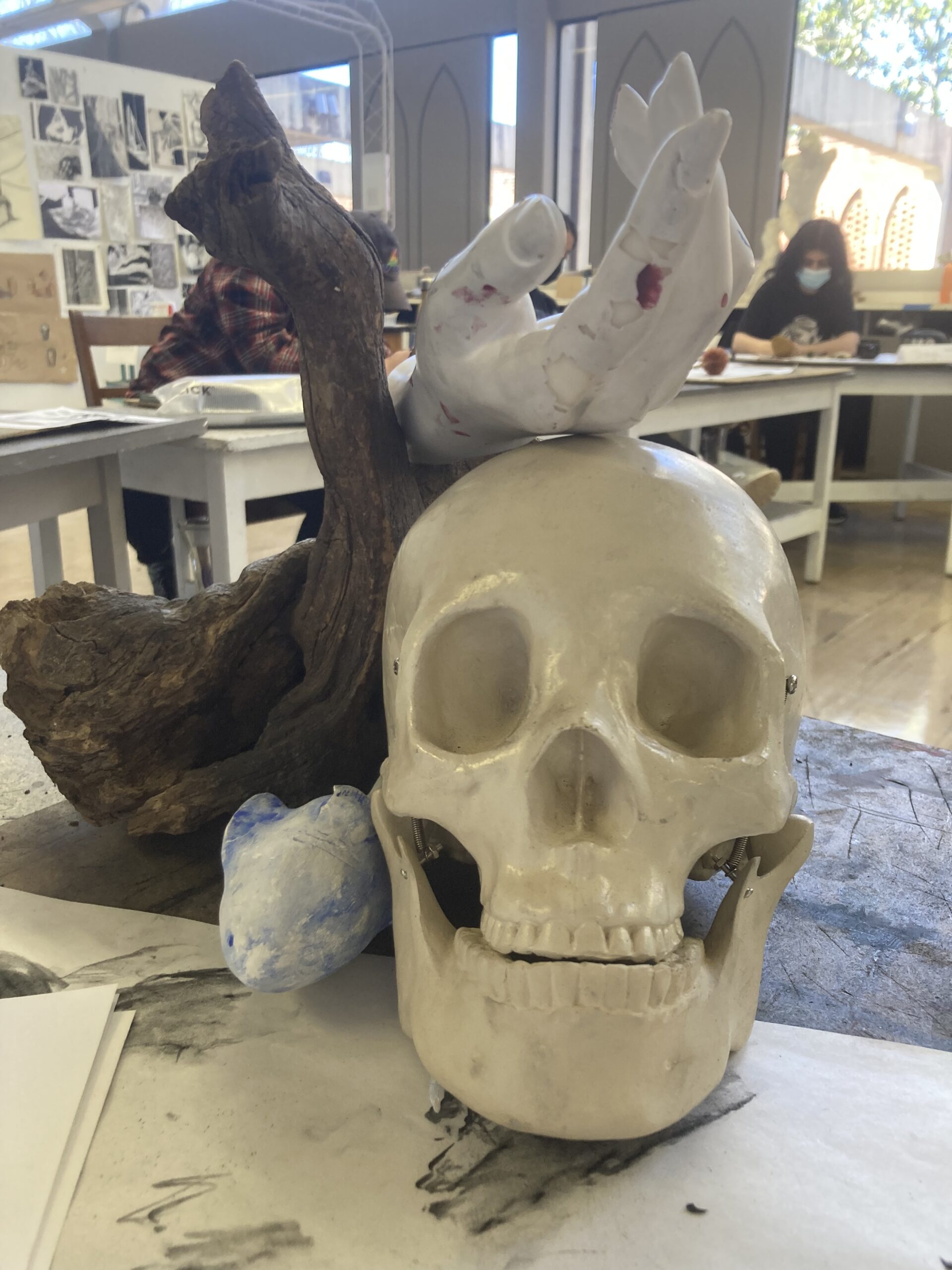
The objects that I initially chose for my mid-term were everything but the rope. I wanted to incorporate the skull again from my 4-drawing assignment because of its reflectiveness. I am very comfortable drawing skulls and hands so I knew I would be able to execute those two objects at least semi-decently. I wanted to challenge myself a bit with choosing the bark, I have never attempted to draw bark or emulate it in any way other than for this assignment. I chose the fish because I love marine animals, I liked the smooth yet chalky/clay feel of the fish that I wanted to try and replicate that in the drawing. The rope, lastly, was an after-the-fact addition to my composition. I had sketched everything out on the page when I noticed that there was a lot of white space that I felt needed covering. I added in the rope because of the texture and the way I could make it flow in my composition.

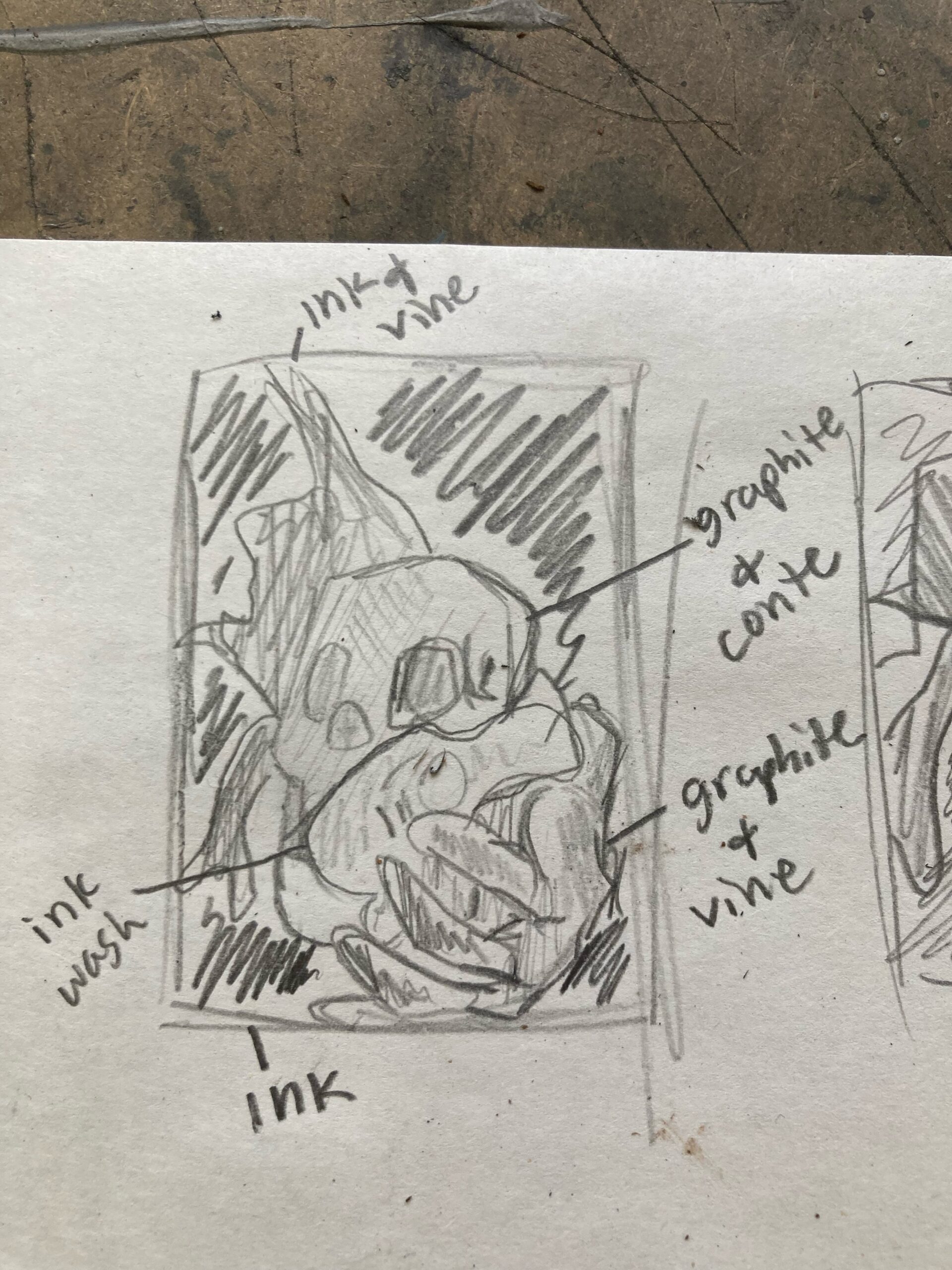
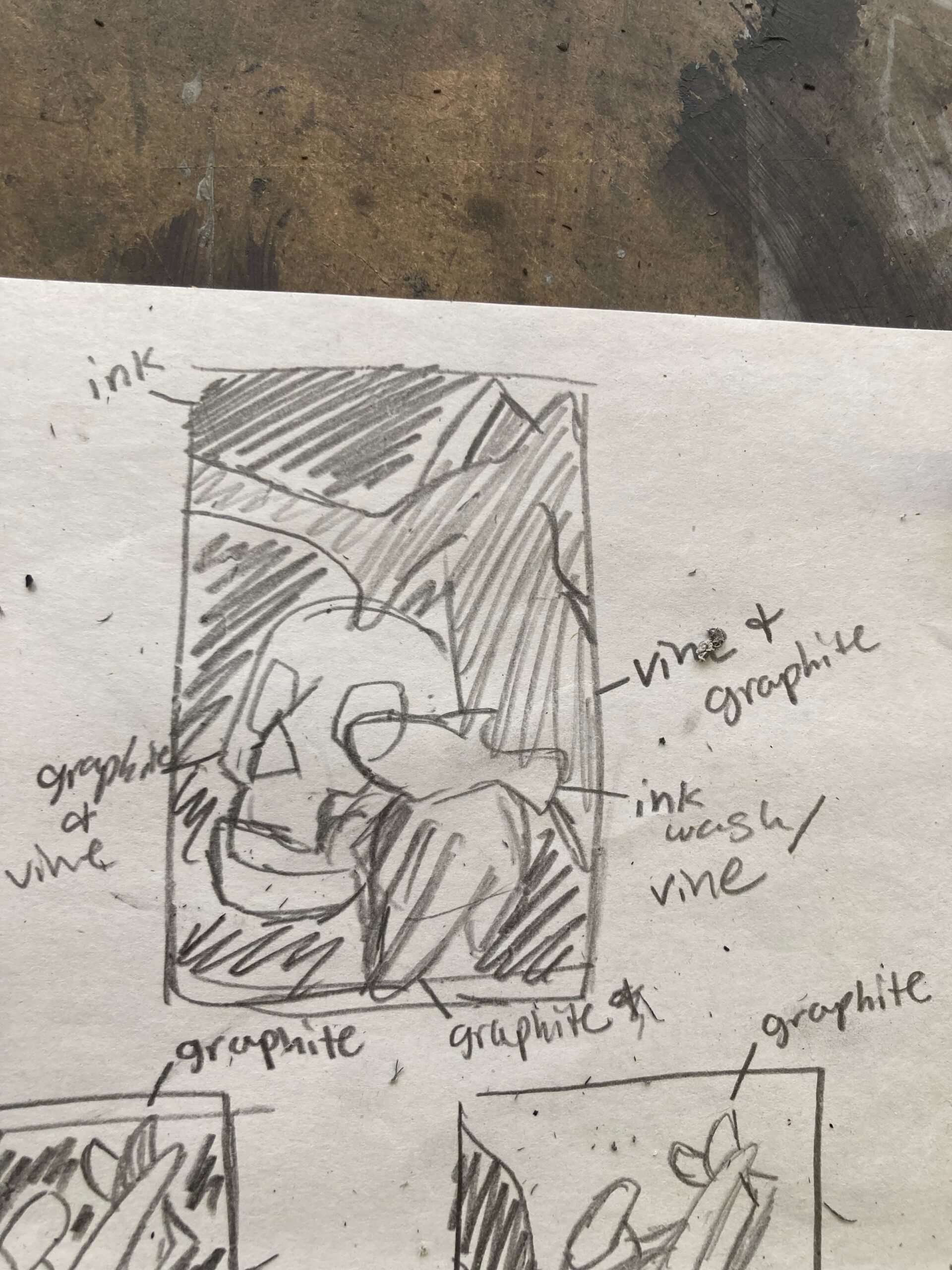
Thumbnails

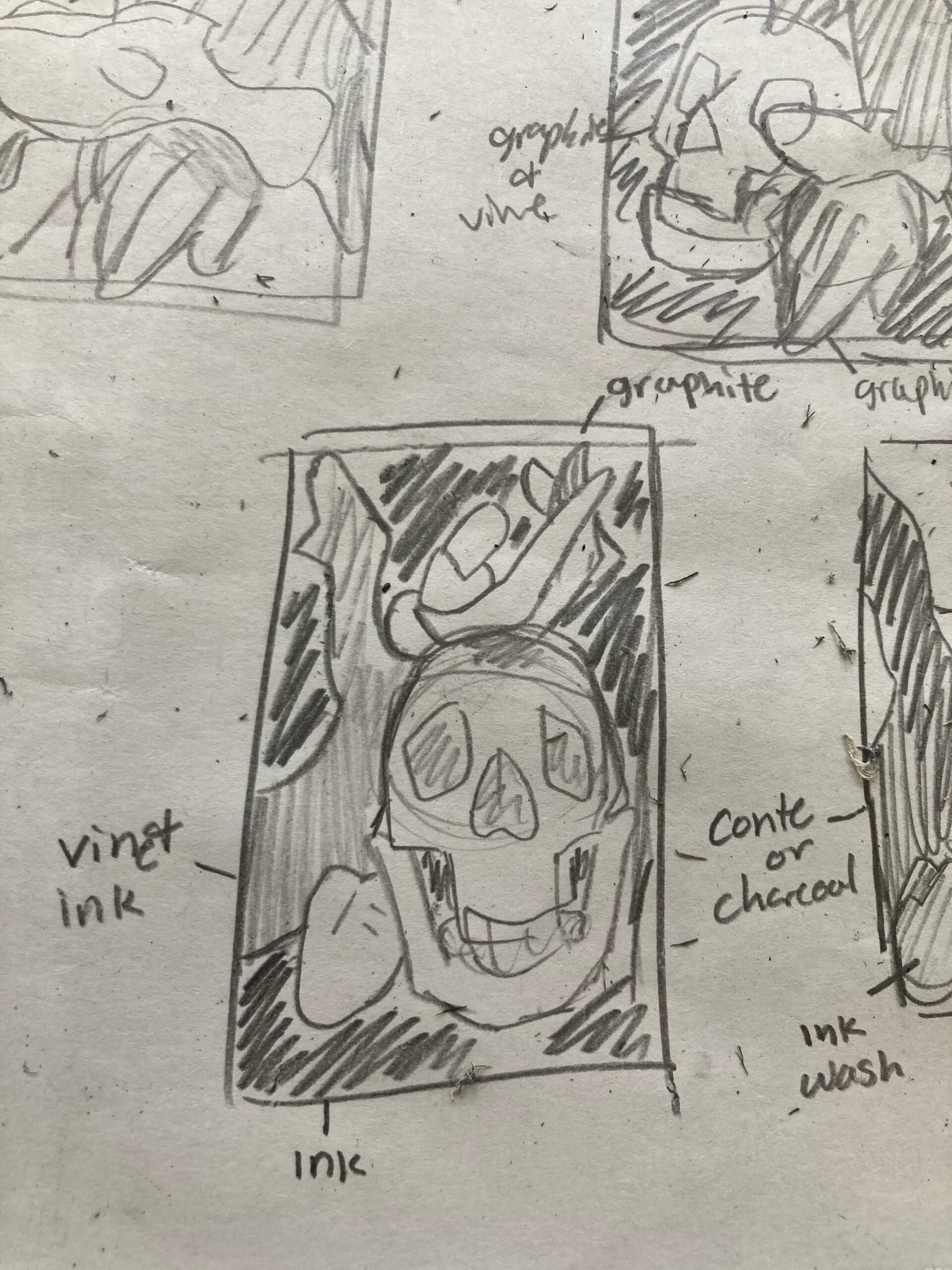
I did about 6 thumbnails for this mid-term but I can only seem to find 3 images of the thumbnails I submitted for grading. Each thumbnail is an attempt to figure out the spacing on a page and finalize which composition I wanted to do. The materials I did end up choosing for this piece were India Ink, graphite stick, Mars Lumograph, a few sketching pencils, brown paper, a sanguine crayon, and a conte stick. I ended up not using the vine charcoal, charcoal pencil, ebony, and charcoal sticks because I felt they would be too heavy-handed in value on the specific objects. The Ebony pencil, at least leaves, streaks of metallic reflections if rubbed too hard which I didn’t want.

Final Drawing

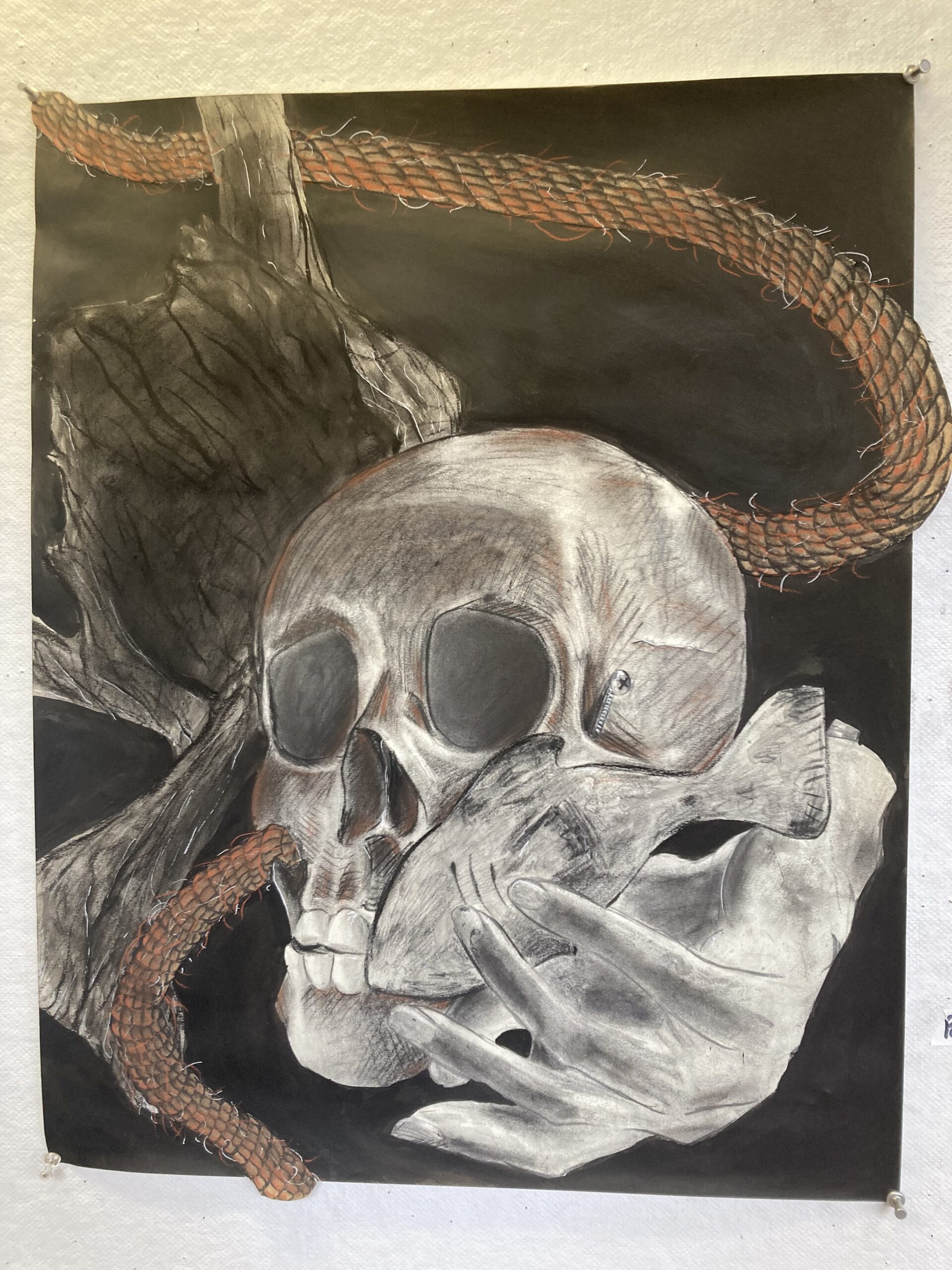
At first, I didn’t have a plan for which I wanted to follow exactly. I had spent a couple of days just testing out different materials to get more comfortable with them before actually putting them on my drawing. When sketching this out I make sure to try sketching with my shoulder instead of with my wrist. Since this was a large piece, I wanted to try my hand at different drawing techniques. I also kept moving around the piece to look at it from different angles so I can get my mind going with how I would go about using the materials. I first sketched out the objects on paper and when I noticed that there was more white space than I wanted, that is when I added the rope in the back to draw the eye and cast it down the drawing. I started off trying to cover big sections, I took the graphite and covered the hand and fish. I used a watered-down India ink and covered the bark. I glued down the brown paper in the shape of the rope and used the mars lumograph to outline the rope’s pattern. I used my blending stump to blend it out and took a white gel pen and the sanguine to make the highlights and frayed wisps in the rope. I used the India ink and conte on the bark to emulate what the bark looked like. I didn’t blend anything out on the bark but kept layering on the washed-out India ink to build up the values. I mainly used the graphite stick on the hand, I wanted this object to be softer than the rest of the other objects. I did this by trying not to use many harsh and sharp lines. The fish was a bit of a surprise to me on how it would turn out. I used the conte and India ink to try and make it look clay-like. Upon layering on the ink, I ended up ripping the paper near the fin of the fish. I wasn’t worried when this happened, I actually thought it added another layer of texture that I could work with. Lastly, with the skull, I used graphite, conte, and the sanguine crayon. I started off using sharp lines on the edges of the skull and in the more prominent areas of the skull. I kept erasing areas to show highlights and adding on darker materials to make the contrast even more visible.

One aspect I liked about the drawing is the use of the orange sanguine crayon. I liked how it made the drawing pop in a sense. When I added it to the skull, I felt I really brought the entire drawing together. Things I didn’t like about my drawing are the bark and parts of the actual rope. I feel I didn’t put enough effort into those sections and that I could’ve spent a lot more time on those, and some more planning as to how I would execute those areas to how I wanted to. I felt like for this assignment, just like my 4-drawing assignment, I didn’t put any detail into the background. These are just floating objects that are arranged into a specific composition. I feel like I am not comfortable making any backgrounds, it is easier for me to focus on the objects themselves. For future assignments, I hope to do more in the background of the objects than just leaving them a solid color.
4 Drawings

4 drawing assignment
Art 160 – 4 Drawing Assignment – Analysis

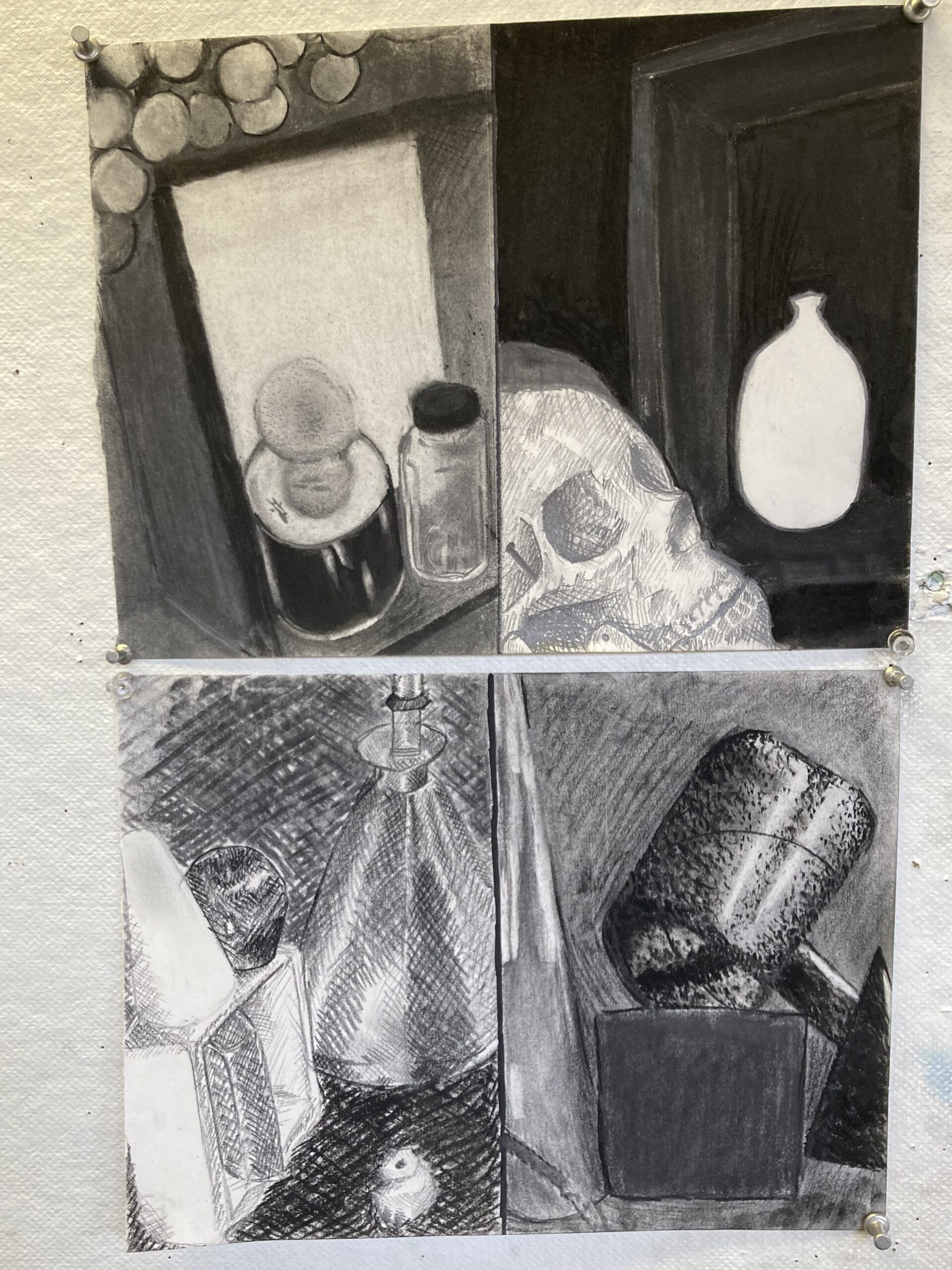
My 4 drawings for Art 160

Bottom: left is my 1st drawing and the right is my 2nd drawing

Top: left is my 3rd drawing and the right is my 4th drawing

Process: My first thought when touching upon this assignment was that I wanted to do well but also wanted to try different techniques with the materials I was provided. This assignment was similar to the other art classes I had taken in school, I heard a lot of these technical terms like cross-hatching, hatching, stippling, contouring, blending, shading, etc. I started my first drawing by making what I was comfortable with, cross-hatching. The thumbnails I did for this composition were stuck between a horizontal and vertical composition. With help from my professor, I ended up choosing a vertical composition for all of my drawings. My second drawing wasn’t the best and after a while of fiddling with materials, composition, and the possibility of starting over, I had to move on from it because it wasn’t sparking anything in me. I didn’t like it and the best thing I could’ve done was to move on and start another with fresh eyes. My third drawing was my favorite, the perspective I chose was more of a top-down view from an angle. I left little detail in the grapes and added more in the 3 objects towards the bottom. I tried making the box a line for the eyes to follow when looking at my main focal point for that drawing. My fourth drawing was also a favorite of mine. I liked how I left the vase in the back in a positive light and my cross-hatching on the skull. I would’ve liked to have improved the darker values within the piece itself. The box is almost muddled into the background, I could’ve taken my graphite stick and ebony to have made it stand out but other than that I was content with the outcome of the drawing. I enjoyed making all of these drawings, even if I wasn’t satisfied with the end result of them, and I loved the process of seeing the pieces all come together towards the end of it.

Materials: The materials I used were, a vinyl eraser, gum eraser, kneaded eraser, blending stump, ebony pencil, a couple of graphite pencils (sketching), mars pencil, charcoal pencil, graphite stick, compressed charcoal, conte stick, and vine charcoal. I liked using the compressed charcoal the most. It was a very smooth application when it made contact with the paper and even when adding more pressure to the drawing, the dark values were very clean. I used that primarily when adding a darker background or to really dark parts on the objects. I didn’t favor using the charcoal pencil and graphite stick mainly because of the application it has on paper. It was hard to smooth out the lines with a blending stump and the values weren’t my favorite out of all the materials I used.

My favorite: My favorite drawing I have up here is my 3rd drawing. The overall composition and perspective of the objects were a lot more interesting than my other drawings. I liked that the focus of my drawing was put on the objects rather than anything in the background. I put a lot of detail in the can and the glass bottle because I wanted that to be my main focal point. For the bottle, I did a subtractive method using the gum eraser, ebony pencil, and mars pencil. The cap of that bottle was made with compressed charcoal and charcoal pencil. I used my graphite stick when sketching the overall composition of the drawing, vine charcoal in the background, and the Conte stick in the border of the box. I enjoyed making this drawing over the others because I felt I put a lot more time and thought into this one than my other three.

My least favorite: I didn’t necessarily like my 2nd drawing out of the 4 I have up there. The values are the dark and light feel muddied, I tried a stippling technique on the hammer-shaped object that didn’t turn out well, and the vine charcoal in the back kept smudging while I worked which was a tad annoying. The composition of the drawing felt very linear, I wasn’t successful in executing the depth that I wanted in the drawing that I had originally seen in the photo I took. I feel like I could’ve turned the drawing into a positive-negative design, which probably would’ve helped the shapes stand out without muddying the overall image. I also think that if I changed the composition of the drawing or taken a better photo I could’ve done better with the object I chose to draw.

Closing: Overall I enjoyed this assignment, and I look forward to diving more into these techniques. I hope next time I will be able to do a blind contour or a positive-negative drawing. I struggle a lot with proportions so hopefully, I will be able to work on that in future assignments.

css.php